Warning: The following contains spoilers for Episodes 1-3 of Gachiakuta, now streaming on Crunchyroll.
I was gonna turn the title of this post into something like “This Anime is Trash” or something evocative of the central motif of garbage present in the story, but then I remembered that every reviewer on YouTube has already made that joke. I also remembered not immediately picking up on the joke and getting a little pissed, thinking, “What the fuck are these people smoking?” The thing is, it’s undeniably effective clickbait; it just already feels played out (not that my title ideas are any better, clearly).
To the surprise of no one who has read my writing before, I love Studio Bones. Their shows have consistently been among my favorites of all time, be they original projects or adaptations, and for over 25 years, they’ve been a shining beacon in an industry full of beloved studios. But sometimes I feel like I need to brace myself for the day when my favorite studio will “fall off”. I’m not getting any younger, and the same can be said of the artists behind my favorite works of film and television.
I think it was The Canipa Effect on YouTube who said that studios aren’t actually important. What matters are the artists behind the studio. When you get right down to it, it’s not “Bones” that I have to thank for my favorite shows. It’s the producers and founders like Masahiko Minami, character designer Toshihiro Kawamoto, and the late Hiroshi Osaka. It’s also Bones’ directors, like Tensai Okamura, Takuya Igarashi, Rie Matsumoto, Kenji Nagasaki, Masahiro Ando, and none other than Shinichiro Watanabe.
Of course, I say all this, but Bones still has that dog in them. Mob Psycho 100 is one of the most well-animated TV series of the past decade. Bungo Stray Dogs continues to be one of the highest-quality manga adaptations out there. My Hero Academia Season 7 was so good that I tried to nominate it for Anime of the Year at this year’s anime awards (albeit to no avail). Like, come on, they just announced a new adaptation of a series from the creator of Fullmetal Alchemist. They’re doing fine.
The thing is, studios change. It’s natural, because the people working there age and pass what they know down to new people. Those new people might kick ass and bring the studio into a brave new era, and maybe those new people fuck it up. Most of the time, it’s nothing so clear as either one of those. I guess what I’m trying to say is that, in trying to prevent myself from becoming a bitter old man or a stan that refuses to criticize something, I want to be more critical of Studio Bones. You see, it’s just a little tough, though, because so far, Gachiakuta is pretty fucking cool.
“Change This Shit Heap of a World”
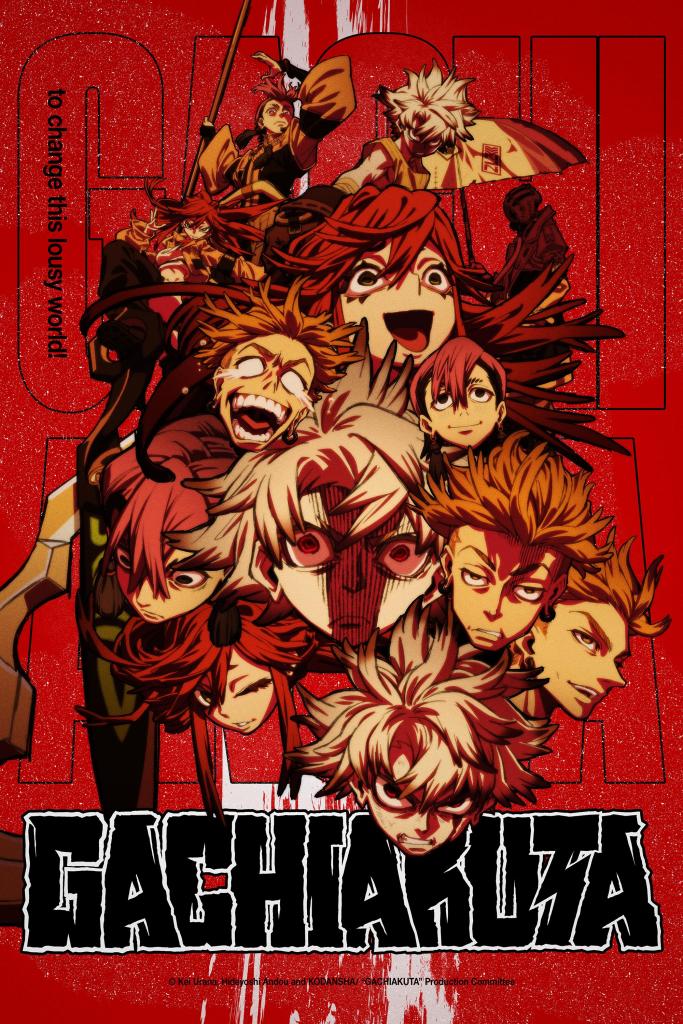
This is a rather unique experience for me, because for the first time, I’m writing my first impressions for an anime AFTER having actually read the manga. Longtime readers of my blog may know I’ve mostly been an anime-only fan for as long as I’ve engaged in the medium, so having that extra dimension of familiarity with the story going in was new for me. Likewise, I’m filled with joy to report that, so far, this adaptation is very well done.
Based on the manga series by Kei Urana, with graffiti art by Hideyoshi Ando, Gachiakuta is the directorial debut of Fumihiko Suganuma. Suganuma was previously an episode director on projects like The First Slam Dunk, Uma Musume, and Shirobako, but Gachiakuta is his first time as series director. In a world where objects treated with care are said to become inhabited by souls, the story begins by posing a question: What happens, then, to the trash we discard? To answer that question, we’re introduced to our hero, a young boy named Rudo.
Rudo lives in the Sphere, a world sharply divided between the opulent “Sphereites” and the lowly “tribesfolk”, in which he falls squarely in the latter. In a setting so obsessed with purity, where the architecture and fashion are all an almost blinding white, accented only with shimmering gold, the “filth’ stands out all the more prominently. After all, either by custom or decree, the tribesfolk wear the same style of clothes, just dirtier. Poverty is a status that stains one in the eyes of those above them in the hierarchy.
The Simple/Extreme Way Gachiakuta Illustrates Its Evils
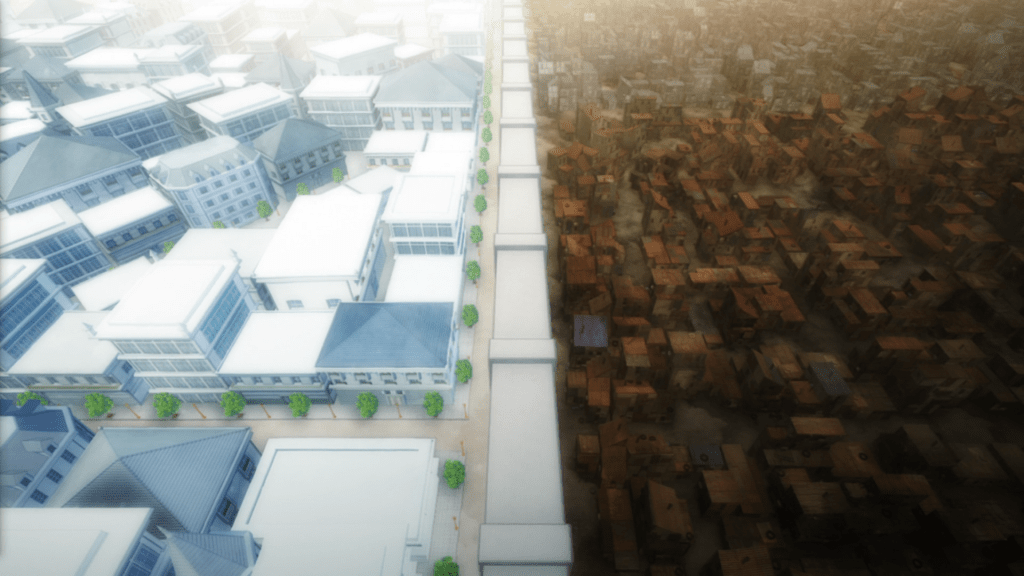
It’s a vision of wealth inequality taken to such simple visual extremes as to illustrate its evils with equally simple nuance. When we encounter Rudo, he’s broken into the waste collection facility, one of many such raids that have earned him the title of “Trash Raider”, although he never asked for the name. He’s not some self-proclaimed rebel, just a boy who sees the value in what the sphereites would so easily throw away; things like the cute stuffed animal that just needs a little mending. He’s sentimental in that way, a charm that few can see beyond the stigma wafting off of him more potently than the stench of the slums.
See, Rudo’s father was a murderer and was thus cast into the pit, where the Sphereites dump all criminals, with as much ease as they discard everything else. Even his fellow tribesfolk see Rudo as an outcast and bear anger toward him for incurring the wrath of the Sphereites. The tribesfolk aren’t just afraid of their overlords; they’re deluded into thinking that if they can just abide by the law, it will save them from their plight, when the system is rigged against them from the start.
The two sources of light in Rudo’s life are Regto, his adoptive father, and Chiwa, the girl he has a crush on. By the end of the premiere, he’ll have lost both. Regto is killed by a mysterious assailant, Rudo is framed for the murder, and rather than believing his story, Chiwa turns her back on him, finally convinced that the boy she liked must have really been as evil as everyone told her. With all love torn from him, all Rudo has left as he’s dropped into the pit is rage, and Regto’s dying words blaring in his memory: “Change this shit heap of a world.”
Why Gachiakuta’s Premiere is So Effective
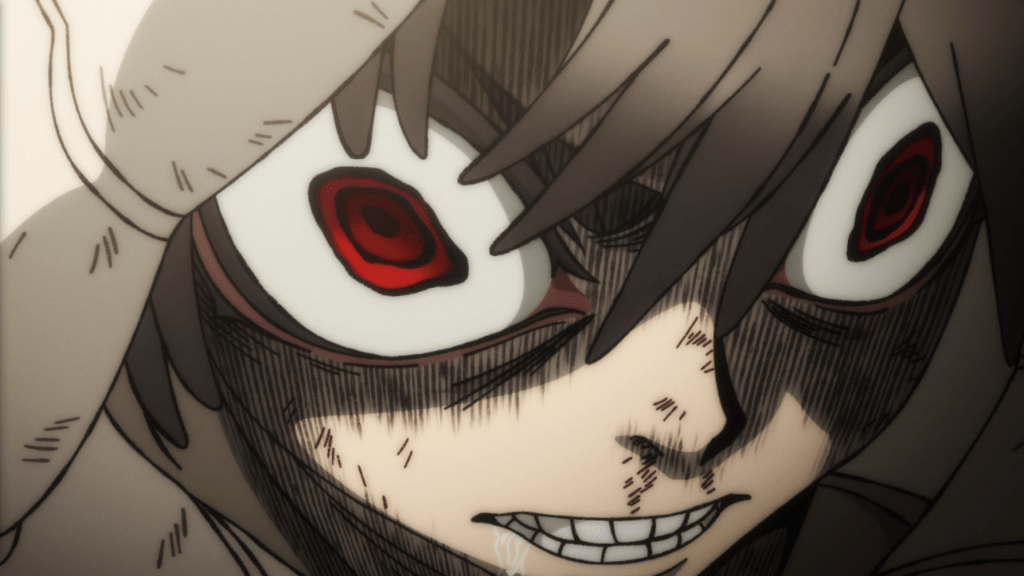
Gachiakuta accomplishes a lot in a single episode, itself a beat-for-beat adaptation of the already dense yet concise first chapter of the manga. In just 23 minutes, we come to understand the disparity this world is built upon, loathe the hypocrisy born of it, and most of all, we share in Rudo’s rage at the senseless consumption of life, to say nothing of how it wastes everything else. And because the Sphere as a setting will largely become nothing more than a goalpost driving Rudo’s quest forward, that rage means everything.
It makes the limited time spent on the Sphere worth it. Too much, and it would have felt like a waste by the time Rudo was dropped into the real world below. Too little and the story would be robbed of all emotional investment. I say this not only in response to some reviews that found the beginning slow and underwhelming, but also because I, too, was eager to see more by the end of the premiere, especially knowing what came next.
Thankfully, the next two episodes did not disappoint, even if the extra week between episodes two and three tried my patience somewhat. Still, I’ve written in the past about the changing landscape of shonen and the overall shift in pacing therein, where it feels like stories aren’t allowed to start slow, so it would be a little hypocritical to not give Gachiakuta time to breathe. I mean, according to MyAnimeList, we’re getting 24 episodes out of this season. That’s a treat in itself, so I’m more than content to let the animators take their time with it.
Rudo Enters the Pit
Episode 2 is the true beginning of the journey, introducing us to a new world through Rudo’s fresh eyes, establishing the threats lurking within, and delighting in the power system that will let Rudo conquer said threats. Having been dropped right into No Man’s Land, Rudo comes face to face with the trash beasts, the natural foes of this unfamiliar world, and the answer to the question posed in the premiere. In this world, a power known as anima gives life to objects, turning this wasteland of trash into a breeding ground for monsters.
However, a special few are capable of harnessing anima for themselves, turning ordinary objects into weapons capable of slaying these trash beasts; the “Givers”. In fact, only weapons infused with anima – so-called “Vital Instruments” – are even capable of killing these beasts for good, a lesson Rudo learns after putting up quite a fight himself. Enter Enjin, who saves Rudo, wielding a humble umbrella that he turns into a bladed parasol that can grind monsters into dust, or charge into them like a lance. It’s an awesome fight scene, elevated by Taku Iwasaki’s score and his signature blending of genres, which has only become more refined over the years.
There’s a distinctly cinematic quality to the instrumentals that evokes the works of Zimmer or Göransson, but also an unmistakable hip-hop flair in the vocals that is purely Iwasaki. This fight is rad, and it’s a shame that some will overlook it based purely on the CGI trash beasts. Having done a lot of coverage of shows with garbage CGI, though, I have to say that Bones did a great job blending 3D into the aesthetic without looking too jarring. In a rare YouTube comment section W, I think one user put it best: “CGI isn’t bad. Bad CGI is bad”.
How Do You Make A World of Trash Look Cool?
Having been saved by Enjin, Rudo’s head is spinning with questions, but his rage just barely keeps his mind on one track: getting back to the sphere to get his revenge. Seeing as how the kid doesn’t quite understand the situation he’s in, Enjin decided to give Rudo an object lesson in exactly the kind of world he’s been unlucky enough to find himself in. He leaves Rudo chained up to be found by some of the locals, whose seeming concern for him is quite disarming, so much so that he doesn’t realize the danger he’s in until it’s too late.
Back in his home, Rudo was at the bottom of the hierarchy, but to the people living in the world beneath him, where all their trash has polluted the air and created monsters, he may as well be the same as the assholes who threw him down the Pit. It’s a sobering moment, and also the point where I became quite impressed with the task Gachiakuta set before itself. To say that Kei Urana’s artwork is great is a gross understatement. The sheer style and personality radiating off the page make the influence of Atsushi Ohkubo abundantly clear. Yet, this is also a story about trash and filth, the setting and themes of which reinforce an unenviable position for our heroes to inhabit.
What I’m trying to say is that sometimes, Gachiakuta can be gross, and effectively so, without ever compromising just how cool and stylish it is in spite of that, and striking that balance is impressive. Obviously, it’s not quite as disturbing as something like Texhnolyze, but when Rudo is forced to eat trash, or when he bites the flesh right off one of his captor’s fingers, it’s just enough. It’s edgy, it’s grunge, and it feels entirely at home in this setting, with this score, and Satoshi Ishino’s faithfully striking character designs.
Rudo’s Awakening, and What Makes Him Special
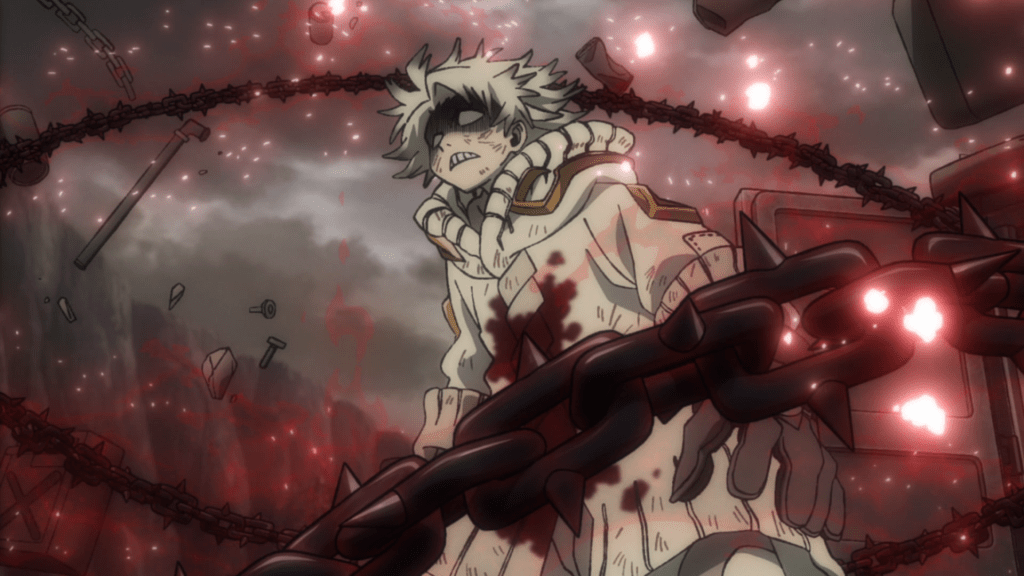
All of that, at least in this episode, is in service of the moment that Rudo has had enough; the moment we get a taste of what kind of power sets him apart from the rest.
Everyone I meet keeps talking… about “Sphere” this and “Ground” that… “Trash” this and “tribesfolk” that… “Up here” this and “down here” that… Quit sorting people with the labels you choose!
Unlike most Givers, who can only imbue a single object with anima, Rudo and his gloves can turn any object he touches into a Vital Instrument, much to the chagrin of his captors, and to the delight of Enjin, watching from on high. With his captors thoroughly trounced, Enjin offers to give Rudo all the answers he seeks about this unfamiliar world and the powers he’s harnessed, on just one condition. He has to join “The Cleaners”, the organization built to slay trash beasts.
Episode 2 exposits the necessary information about its world as effortlessly as the premiere. It’s a drip-feed of worldbuilding and intrigue punctuated by some stellar action and all presented with a distinct grime. I find that when it comes to shonen, it’s not about what fundamentally sets a story apart from its peers that makes a difference, but the personality and energy with which it hits familiar beats. It’s why people are often forgiving of new shonen anime and encourage people to let the story develop and ease into a formula from which it can truly wow us.
Consequently, that’s why IGN’s review of the first two episodes ruffled so many feathers, but I understand being underwhelmed. I wonder if I might have felt the same if I hadn’t read the first three volumes before watching, because while Gachiakuta is good, it wasn’t until Episode 3 that I felt truly excited by the adaptation. By this, I mean it was the first instance where I felt that the anime was not just telling me the story I had read, but also contributing something significant to the aesthetic that allowed me to see the story in a new way.
Episode 3 Is Where the Fun Truly Begins
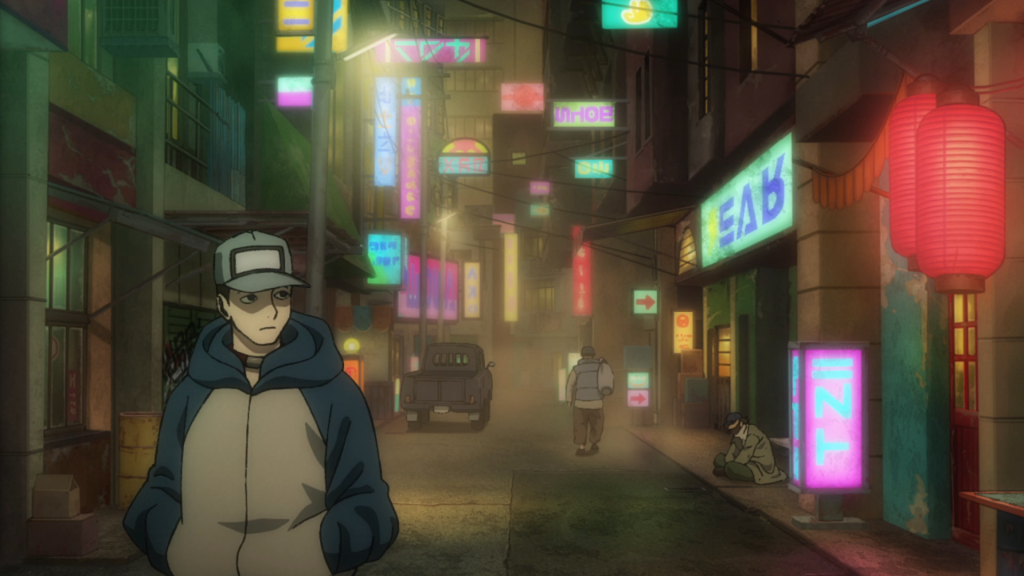
Obviously, there was already the music and the animation, but it was the little details and character beats where I truly started to fall in love with this world. To see the city streets in color, the neon signs glowing in the alleys, and the dingy yet lived-in interiors made all the difference. Additionally, the dim yet colorful aesthetic felt quintessentially “Studio Bones” in a way that reminded me of Darker than Black, Soul Eater, or something as niche as Blast of Tempest.
More than anything, I appreciated how the third episode was almost entirely centered around adapting Chapters 5 and 6, and thus the introduction of Zanka, another main pillar of the cast. Again, maybe I’m overanalyzing the episode count allotted to this adaptation and conflating it with the way anime “used to be made,” but so far, the pacing feels oddly nostalgic. It doesn’t feel like it’s rushing to get to all the intense shit in volume 3, and thank goodness, because the first meeting between Rudo and Zanka is hilarious.
I feel like I’ve neglected to really dig into why I love Rudo as a protagonist. From the outside looking in, it’s easy to see his grimace and the rage that pushes him forward, and think he’s just an edgy, angry boy. I’ve seen comparisons between him and Bakugo from My Hero Academia, both in good faith and not, but he is uniquely adorable in a way that Bakugo didn’t achieve until much later in his respective series.
Rudo’s Rocky Road to Making Friends
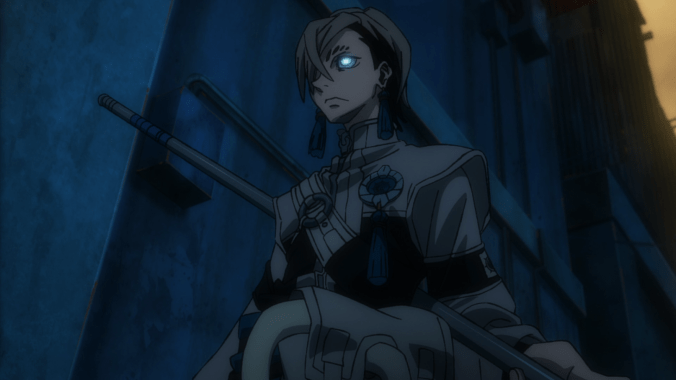
When Rudo meets Zanka, the Cleaner who Enjin assigned to train him, they do not get off to a great start. Rudo has a hard time expressing himself, much less cracking a smile, and it’s not a surprise why, given what he’s been through. He never had any friends, but he did have a good father figure in Regto, and I really love how he lives on through Rudo’s memories, slowly helping him get out of his shell. Rudo has good reason to be angry at the world, but as Regto pointed out to him when he was a kid, indiscriminate anger can breed more contempt.
Rudo. If you want someone to listen to you, try making the first concession… You’ve got to cool off and think about how the other person feels.
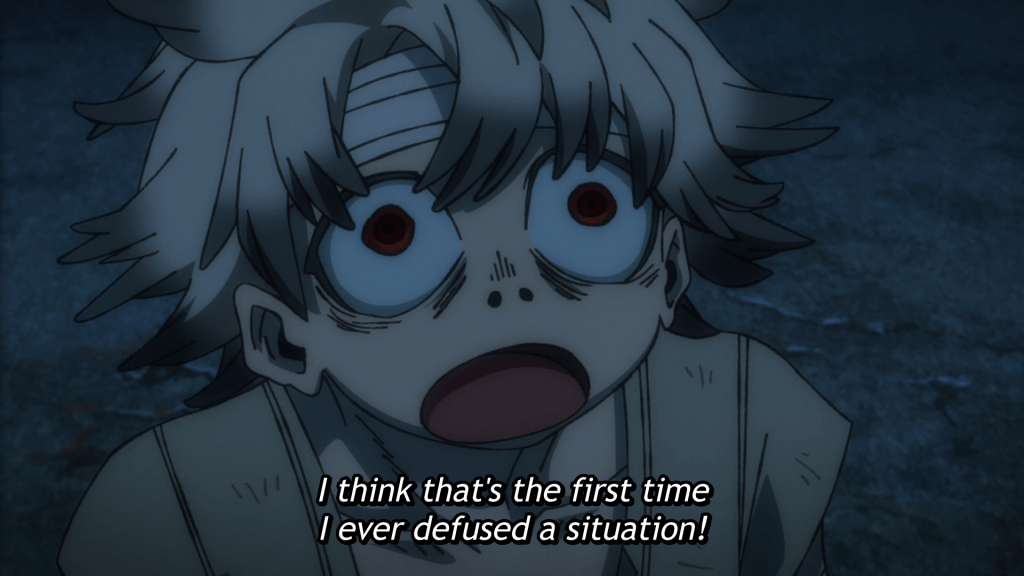
In applying this lesson, the tension instantly melts between him and Zanka, who was only so angry at Rudo for temporarily borrowing his Vital Instrument. The concept of de-escalation is so alien to Rudo that he just stares blankly, and his expression is at once hilarious and also utterly adorable, a look that we will be greeted with many times in the weeks to come. Granted, it doesn’t last because Rudo’s subsequent attempt at a friendly “smile” is so haunting as to present a sight more unsettling than even the trash beasts, and Zanka, being quite the weirdo himself, takes offense.
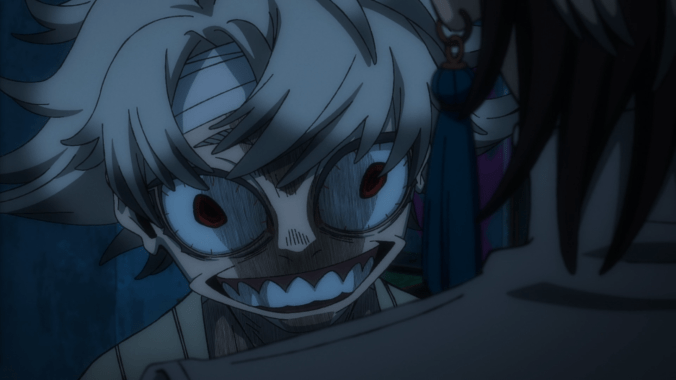
Seriously, though, it’s worth admiring just how they animate Rudo’s creepy smile. The way his head bobbles as he talks almost looks like the animators used the same blend of 2D and 3D that they used for the trash beasts. Combined with the music cutting off, it takes an already funny scene from the manga and elevates it.
The ensuing fight is equally charming, if again, more than a little gross on account of Rudo turning a dirty toilet plunger into a Vital Instrument. I’m not a fan of scatological humor 99.99% of the time, but Gachiakuta might be the only series that manages to get a pass, if only because it gels so seamlessly with everything else (that’s not to say I’m eager to see more literal shit in future episodes though).
Looking to the Season Ahead
Gosh, is this what manga readers have been experiencing all these years? Watching a show and actually knowing what happens next? What a revelation. Joking aside, I’m beyond excited to see how Bones (sorry, Bones Film) handles the upcoming chapters, especially when guys like Jabber show up to wreak havoc. Plus, considering I haven’t been able to find Volume 4 in stores near me, I’m sure I’ll be watching this anime blind before long, but either way, I’m sold on this series.
For anyone like me, who perhaps has struggled to find the motivation to watch the newest hit shows and is paralyzed by choice when factoring in their backlog, this show is well worth keeping an eye on. Especially now that My Hero Academia is ending this fall, seeing what this studio does in the shonen landscape next is beyond exciting, and it’s not like they weren’t already proven hitmakers before that series.
It feels like every year, people find a new handful of shonen manga to prop up as the new pillars of the genre in this brave new world we find ourselves in, and I’m not nearly qualified to act as an authority on the matter. However, I can make observations, and similar to the way that Jujutsu Kaisen author Gege Akutami took inspiration from Tite Kubo and Yoshihiro Togashi, people can see the influence of Atsushi Ohkubo in Kei Urana’s work.
The inspired have become the inspiration, and so on and so forth, and while I may have started this piece entertaining some fear of Bones’ “spark” being lost, shows like Gachiakuta remind me that it’s still very much alive. How bright that light will become by the end of the first season remains to be seen, but I’m very optimistic about this series and the future of my favorite studio.
Thank you for reading! I’m so glad I found the time to write up my thoughts on this series.
As a little addendum, I’m not sure what to make of the change from “Bones” to “Bones Film.” At first, I just assumed it was meant to suggest it would be a single new studio prioritizing theatrical films, but now it seems like it’s just what the studio is calling itself. The point is, as long as they don’t completely overhaul the structure of the studio, I feel like the change is mostly minimal, and from the looks of things, that seems to be the case. There’s even a whopping sixth studio now! And the so-called “Studio F” is working on a new project that, according to Toshihiro Kawamoto, back in 2024, was to be announced this year.
This could be referring to that new Hiromu Arakawa adaptation I mentioned earlier, which was announced not long ago and is being directed by Masahiro Ando. However, he could have also been referring to the adaptation of Fate Rewinder, which is being directed by the queen herself, Rie Matsumoto. There hasn’t been confirmation of which studios are tackling either of these projects yet, but regardless, two of my favorite directors are making new shows at my favorite anime studio… maybe the world is doing fine after all.
To get real, I was recently just officially laid off, so things are a little tough, but being able to come back to this blog really helped lift my spirits, and I hope you all enjoyed reading this.
Stay healthy, stay safe, and I’ll see you in the next one.
 Sakura Sunrise