| Title | Demon Slayer The Movie: Infinity Castle |
| Director | Haruo Sotozaki, Hikaru Kondo (Chief Director) |
| Studio | Ufotable |
| Premiere Date | 9/12/2025 (United States) |
It’s been nearly six years since Ufotable’s adaptation of Demon Slayer concluded its first season, becoming a worldwide phenomenon and earning an admittedly impulsive 10/10 from yours truly. Granted, my love began to wane in the years since, bogged down by the TV anime’s questionable pacing, which created a sensation that not much progress was being made in the story. And now, it’s already coming to an end… well, technically. There’s still a lot more to adapt, I hear.
Demon Slayer The Movie: Infinity Castle sells itself as the beginning of the end, but if anything, it makes the six years between Season 1 and now feel like nothing more than an interlude. Season 1 adapted 53 chapters, but this trilogy aims to adapt the final 66. It’s not just an ending; it’s the story’s next major saga, from its pacing to its beating heart. In that, this film exemplifies the anime’s intervening failings, yet at the same time, it is also a rekindling of its greatest strengths.
Stuff Actually Happens In This Arc!
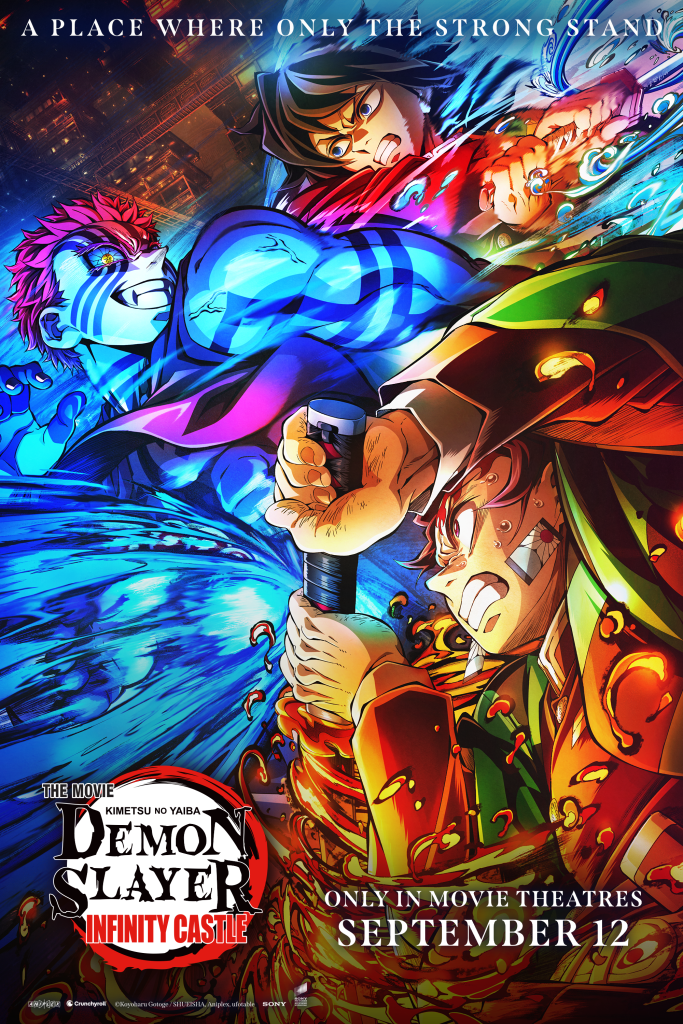
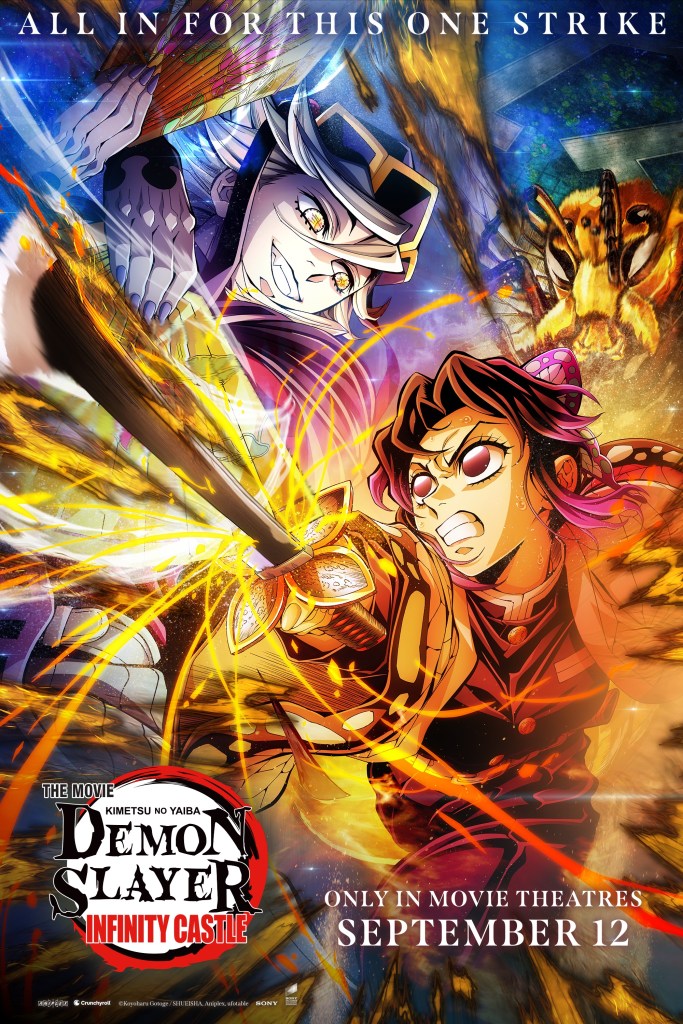
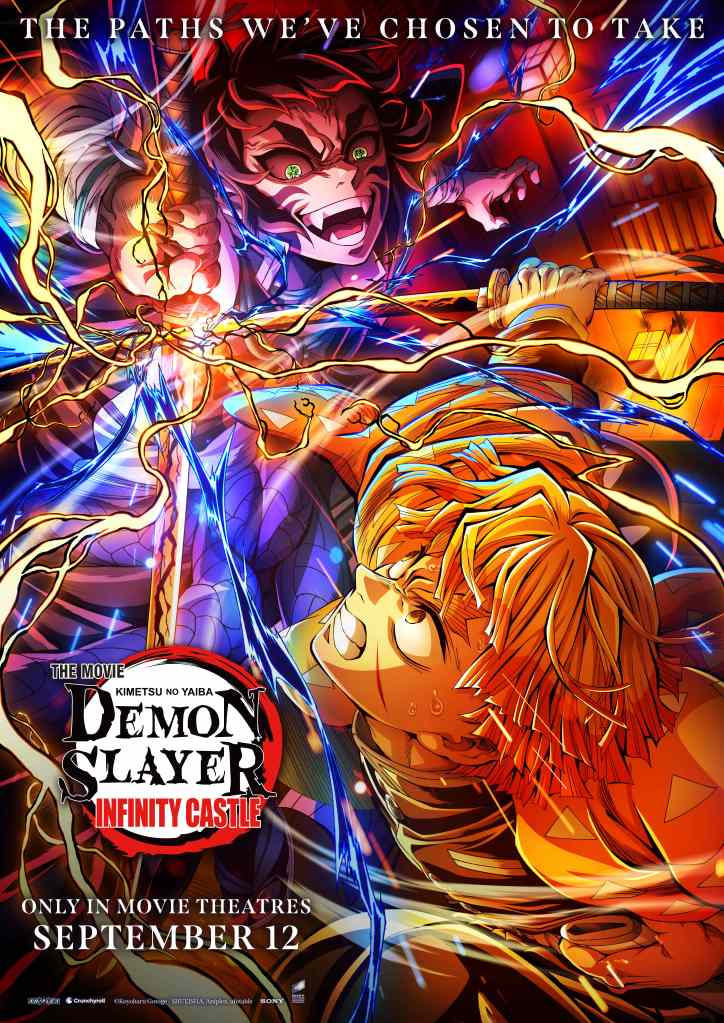
I mean, it wouldn’t take much to clear that hurdle after how meandering the Hashira Training Arc was, but still, there are stakes and casualties, and the weight of it all is not easily lost. Following Muzan Kibutsuji’s arrival at the Demon Slayer headquarters and the subsequent sacrifice of Kagaya Ubuyashiki, Kibutsuji is in a tight spot. He’s been outsmarted and cornered by all the Hashira and will die when the sun rises. In retaliation, he has sent everyone in the vicinity to the Infinity Castle, a sprawling pocket dimension where his demon army will eviscerate them for good, whilst he regenerates and evades his vengeful pursuers.
The opening scene of the film felt like a very intentional callback to the opening of Demon Slayer‘s last great theatrical outing. At the beginning of Mugen Train, we follow Ubuyashiki and his wife, Amane, as they walk through the graveyard of fallen Demon Slayers, whom Ubuyashiki views as his “children”. It was a quiet, somber intro that would come full circle in that film’s conclusion, when Kyojuro Rengoku died in the line of duty. Infinity Castle echoes this scene, following Gyomei, who walks the same graveyard, burdened by the knowledge that his master will sacrifice himself, and meditating on his parting promise to ensure that no more die before the battle is over.
Between this parallel and the large emphasis on Tanjiro’s rematch with Akaza, who murdered Rengoku, there are times when Infinity Castle feels like a direct sequel to Mugen Train. Fitting though that may be, however, the film has many other obligations to push the story forward, and is not always the most elegant in weaving that story. This is nowhere more evident than in the opening act, which at times felt like a collection of vignettes, each one catching up with where each character ended up in this vast maze.
An Uneven, Yet Promising First Act
The intent is clear: Not every character in this large cast will be relevant in this film, but there remains an impetus to spotlight them, even if only briefly, lest they feel forgotten. The larger issue, then, is the editing and how it fails to connect these disparate vignettes in a way that contributes to the flow of the story. Instead, scenes follow one another without much of a thread. Even the score by Yuki Kajiura and Go Shiina feels very video game-y in the way that it starts and stops at times, denoting harsh transitions between scenes, or repetitive musical progressions within them.
Where I felt that the film truly began was with the confrontation between Shinobu Kocho and the Upper Two demon, Doma. It marked the end of the cutting between vignettes, and instead, the film settled into an ominous, foreboding tone preceding the first of many great battles. Plus, it was the moment that I was finally interested in Shinobu again, much less a single Hashira, thanks to a stirring backstory carried by Saori Hayami’s impassioned vocal performance.
That is to say nothing of her opponent, voiced by the incomparable Mamoru Miyano, whose boundless charisma lends Doma a sickeningly sweet demeanour as they delight in devouring humans as a form of “kindness”. A demon who feels nothing while wearing a smile, facing off against a girl burdened with boundless rage, yet who often conceals her feelings. It’s a fantastic premise, executed even better thanks to the unique clash of specialties and the power difference between them. Doma’s ice versus Shinobu’s poison, and it’s not as though Shinobu’s fighting style makes her the best choice to kill an Upper Rank. It’s an underdog fight that grips like a vice.
Zenitsu’s Eleventh-Hour Character Growth
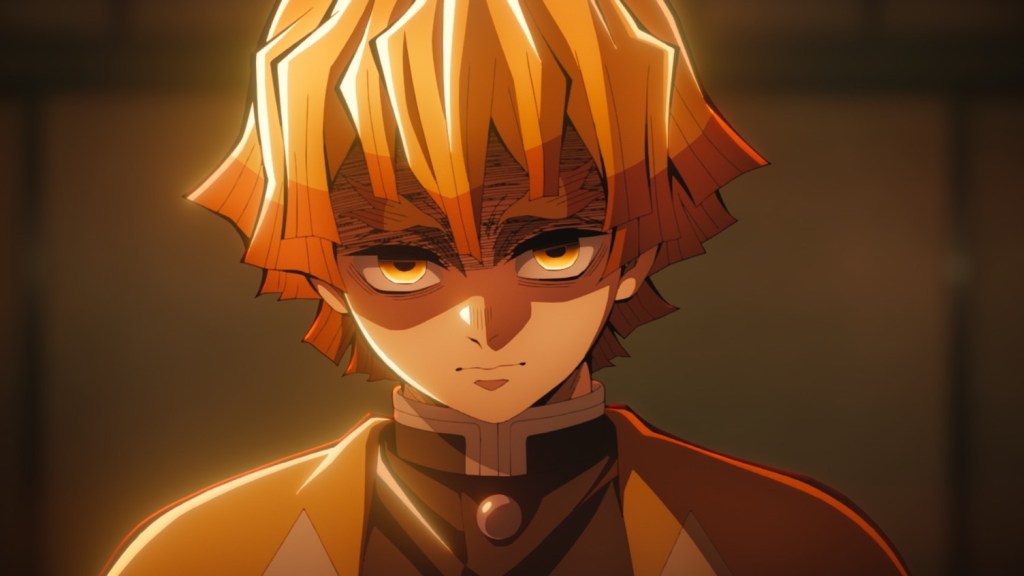
The second standout of the film’s major confrontations is that of Zenitsu versus Kaigaku. Assuming you haven’t recently binged the series, you can be forgiven for forgetting Kaigaku, because I certainly did. I only recognized him because I recently binged (and hated) the Hashira Training Arc in anticipation of this new film, and I thought it strange that a kid from Gyomei’s past was suddenly important to Zenitsu. Then, after the film, I looked him up and realized that he appeared (briefly) in Zenitsu’s flashback from Season 1 (and like, come on, it was six years ago, cut me some slack).
Anyway, after four seasons and one film of exclusively doing cool things when he’s asleep, Zenitsu is finally a more developed character. We see his past with greater clarity and learn to appreciate how he got to where he is in spite of his shortcomings, albeit through the added context of a rival we’ve never gotten to know until this movie. Their fight is really cool, and I love watching characters like Zenitsu step up and show their growth. I just wish his development hadn’t happened so suddenly, and that said growth felt more earned, rather than the result of some hard thinking (off-screen) after receiving a letter in the previous season.
The Hard Truth About Demon Slayer’s Latest Heights
That’s kinda one of the biggest problems with Infinity Castle. As good as it gets, and as much as it works to overcome the anime’s most glaring problems, it can’t quite erase them and the effect they’ve had on the story. The coolest character moments now aren’t going to erase all of the time wasted throwing paper airplanes or jogging around mountains instead of actually getting to know these characters. Especially the Hashira, most of whom are still quite one-dimensional, even if I loved Rengoku (RIP), love Tokito and Shinobu, and like Giyu (he’s fine).
And before someone says it, being able to point to an episode that came out four to six years ago and say, “See? [insert character] did get development!” is not going to magically erase the dead air between then and now in which they remained stagnant. As a reminder, I’ve never labored under the impression Demon Slayer‘s characterization is all that deep, nor that it needs to be. My issue is with the way that the pacing of this adaptation magnifies the blemishes on an otherwise impassioned tale of empathy, willpower, love, and kindness.
How Infinity Castle Won Me Back
Demon Slayer doesn’t need complexity; it just needs passion – earnest and forthright passion. I said before that the weight of this film’s tension is not easily lost, even to one with gripes against this series, such as I. Even at the script’s simplest, the artwork, performances, and music coalesce to hammer home the gravity of this battle in such a way that it’s hard not to be invested. It’s the little moments, like when Urokodaki treats Nezuko, all the while sweat dripping from the corners of his mask, gulping nervously, monologuing about how it feels as though this is “the final stage”.
Or, more heartbreaking, when Ubuyashiki’s children put on a brave face as they carry on their father’s fight and map out the Infinity Castle, reminding one another not to cry. Because they can’t afford to stop. Because they must win. It’s simple, if not subtle, and wholly melodramatic; I love it. It was these small human moments between the wisened and youthful, strong and weak, romantics and realists, all commiserating with one another, that lie at the backbone of all epic storytelling. And beyond pathos, the literal scale of it all is where the film finds similar success.
Loving the Infinity Castle
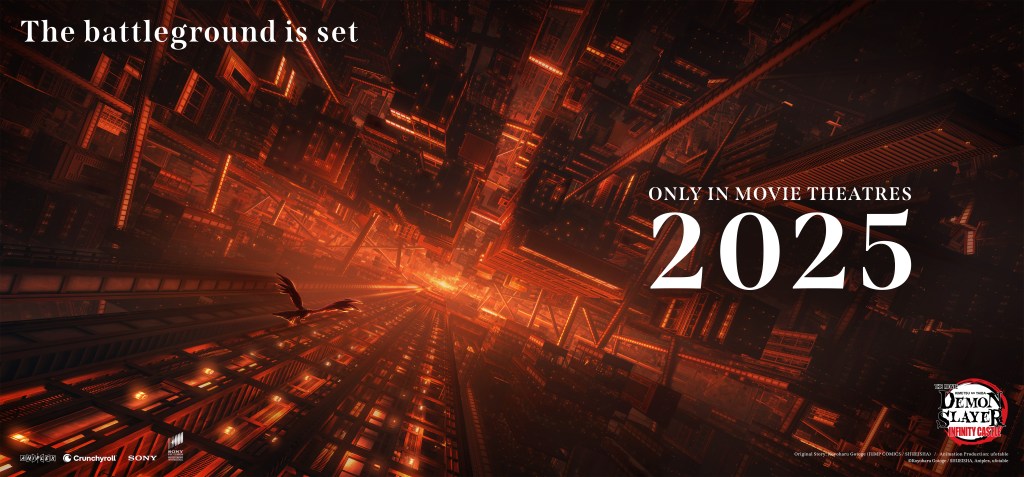
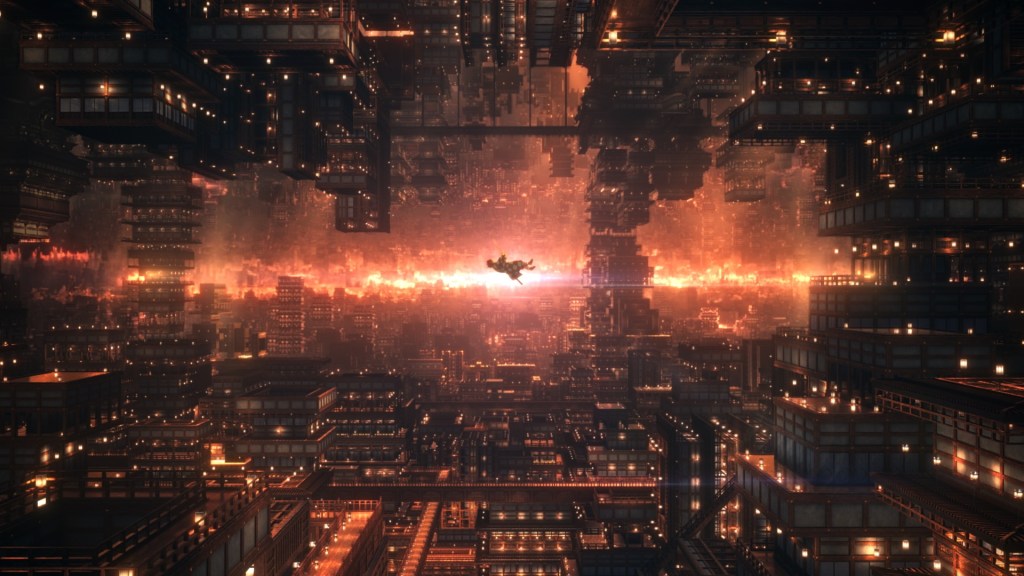
As much as I’ve ragged on previous seasons for staying in one place for too long, it’s hard to hate being trapped in one place when it is as staggering as the titular Infinity Castle. It’s almost an extravagant, Taisho Era-tinged spin on the concept of the Backrooms, but with the oppressive, sterile spaces replaced with equally unnerving and imposing vistas of endless geometry. The warm light and accents of red are at once beautiful, but the way the castle contorts and bends space adds a dash of cosmic horror to the potential of demonic power.
Naturally, the horror of it all is defused somewhat by the protagonists being swordsmen with superpowers, but it’s all the better then that the setting makes for such a striking battleground. With its endless scope, there’s no limit to how far they can run, leap, or throw their opponents. Plus, there’s just enough variety in the interiors to (hopefully) ensure that the setting doesn’t get dull by this trilogy’s end, because this film’s main event certainly sets the bar high.
Tanjiro & Giyu vs Akaza

Of all the film’s battles, big and small, none is more paramount than the battle against Akaza, and by extension, justice done for the fallen Flame Hashira. It’s a pivotal moment that allows Tanjiro to prove how far he has come since Mugen Train, having killed three Upper Rank demons between then and now. Apart from Muzan, Akaza remains the greatest evil haunting Tanjiro, and thus, he is the barrier beyond which Tanjiro can rightfully face the final bosses. In turn, the more experienced Giyu is there to back him up, protecting him from would-be fatal blows.
Giyu’s presence further helps legitimize Tanjiro’s strides to defeat Akaza, rather than having our hero just steamroll the guy. For as chaotic as Demon Slayer‘s fights can get, I am always appreciative of how undeniably exhausted and hurt our protagonists become, to the point of fighting against their own bodies to press on. For all the times that the breathing styles amount to nothing more than different visual effects rather than strategies with quantifiable outcomes, the emphasis on physical punishment is what keeps these bouts from becoming just a visually exhaustive tug of war.
Demon Slayer’s Greatest Magic Trick Strikes Again
I’m doing my best to avoid spoilers in this review, but getting to the heart of why I enjoyed Infinity Castle warrants discussing what made me fall in love with this series to begin with. The problem is that said reason might inform how this film ends, but frankly, for all this franchise’s edge, if you can’t expect at least one bad guy to die in this film, you might be overestimating its scope somewhat. What I’m referring to is Demon Slayer‘s tendency to present the most despicable villains and then find a way to make you feel empathy for them by the time they’ve been defeated.
To that end, I think the last third of this film is incredibly bold for how it cuts away from the action for a prolonged period of time to delve into the history of one of the antagonists. A tragic upbringing, a second chance at an honest life, and a senseless act of cruelty that tears away all hope for a future. It’s one of the first times that Demon Slayer‘s newfound penchant for drawn-out character drama felt appropriate, because it was in the service of stripping away the audience’s preconceptions and getting to know a character from the ground up.
Remembering The Point of Demon Slayer
I didn’t expect to get as emotional at this film as I did, and though it didn’t quite hit me in the same way that the nightmare scene from Mugen Train did, I was grateful for this unexpected turn. Frankly, though, it shouldn’t have been a surprise at all. I’ve seen people disparage this film and the series as of late for an abundance of flashbacks, but from what I can tell, some of the most emotional scenes in the early anime were either earned by – or found within – flashbacks. To take what the audience thinks of these characters at first glance, good or bad, human or demon, and unmask them, says a lot about the story’s message.
With few exceptions, demons are cruel, vicious, and their emotions, thought processes, and priorities are categorically different from those of humans, but because they used to be human, there is considerable power in their final moments. There is beauty in confronting the complex lives they lived, that ended ages ago, without being allowed the dignity of rest, rest that people like Tanjiro have the privilege of giving, assuming they care enough to give it thought. For all of Tanjiro’s strength, his greatest power is and always will be empathy.
One Down, Two To Go
See, now I’ve said all of this and even gotten myself misty-eyed with nostalgia, and yet I feel like people will be pissed by my score for this film, but I really did like it. I just didn’t love it. It is not a particularly excellent movie. As a work of film, it lacks a certain flow and clarity of direction. It is a huge improvement over the Hashira Training Arc, and, though partly by virtue of its medium, far better paced than the two seasons that preceded it. However, what improvements there are come at the cost of rushing to compensate for said flaws and convey what could have felt more earned.
Despite that, I believe the film’s highs outweigh its lows, and not even by all that thin a margin, thanks to the same magic tricks that made this series so emotionally engaging to begin with. I’d go further to say that I am confident that this trilogy can only rise to greater heights from here until the sun rises on the bloody battlefield it’ll have torn to shreds. Some will call it exhaustive, but whether great or just okay, Demon Slayer The Movie: Infinity Castle is an emotion-drenched spectacle that will remind you why you fell in love with this series.
6/10
Demon Slayer The Movie: Infinity Castle hits theaters in the US on September 12, 2025
Thanks to Crunchyroll for the invite to the early screening, and thank you all very much for reading!
Stay healthy, stay safe, and as always, I’ll see you in the next one.
 Sakura Sunrise