[Note: I watched To Be Hero X in Japanese with English subtitles. Any appraisal of vocal performances is made with this frame of reference in mind. However, from what I’ve heard of the English dub, it’s really well done, so if you prefer dubs, you’re in for a treat.]
In a landscape so saturated with superhero media, what does it mean to be truly original? Is it the ideas? The spectacle? Themes? Style? Sure, these can help new projects to stand out in a cluttered marketplace of origin stories and disparate continuities, but amid the genre’s worst lulls, finding originality can feel like a moot point. And frankly, is looking for “true originality” even productive? The foundations of these stories and their messages are timeless for a reason. It’s not about originality so much as nuance, and To Be Hero X might be the best superhero story in years.
And, you know, at the start of 2025, that might have felt like a low bar, especially after such a spineless shitshow like Captain America: Brave New World. Even with Thunderbolts*, Jake Schreier and his team’s commendable commitment to practical stuntwork, strong theming, and heartfelt character drama felt like the exception to the rule. But then we got James Gunn’s Superman, and less than a month later, Matt Shakman’s Fantastic Four: First Steps. These two beloved films weren’t just successful, but reignited faith in superhero movies, to say nothing of hope for humanity in general (especially in the case of the former).
So it’s fair to say this has been a strong year for superhero media, which makes my aforementioned take a lot more contentious. However, while I don’t want to undermine the merits of Schreier, Gunn, or Shakman, I genuinely think To Be Hero X clears all of them by *that* much. But what exactly is To Be Hero X? And why does it deserve to be recognized among the genre’s best and brightest?
Putting To Be Hero in ConteXt

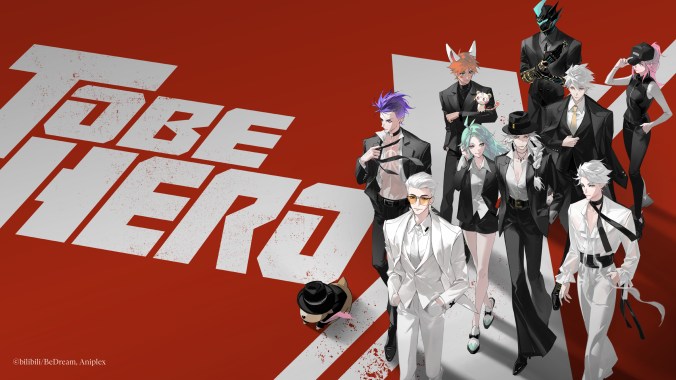
To Be Hero X is a co-production between Japanese publisher Aniplex, Chinese video-sharing site Bilibili, and Chinese animation planning/production company BeDream. The project also unites several production houses from across Asia (LAN Studio, Pb Animation, and Paper Plane Animation Studio), thereby presenting a unique blend of various visual styles, both 2D and 3D. Ever since the project’s announcement in March 2023, it has garnered interest across the globe thanks to a dazzling and musically rich marketing campaign, padding the multi-year development.
This is a pretty special review for me because I’ve been rambling about Japanese animation for years, but Chinese animation (or donghua) has really exploded recently, and I have been way behind. Plus, as it turns out, the director of To Be Hero X, Haoling Li, also directed Heaven’s Official Blessing and Link Click, the two donghua I’ve heard people raving about the most in recent years. So it really isn’t all that surprising that his newest project is popping off like it has; it’s been a long time coming.
Furthermore, this isn’t even the first series of its name. Li also directed 2016’s To Be Hero and 2018’s To Be Heroine, which are… quite different from the look of things. They might not even be in the same continuity, but I haven’t watched them, so I can’t say for sure. Either way, you don’t need to have watched either of them to understand this series. With that said, though, there is a little bit of optional homework before digging into the series proper, and once you get a taste, you’ll be happy you took the time, because the marketing campaign for To Be Hero X is incredible.
How I Got Sold on To Be Hero X
Right from the get-go, Aniplex released a 6-minute-long concept movie showcasing the titular character “X”, his power, and delivering the central logline of the story. Basically, this is a world where heroes are created based on the trust placed in them by the people; everyone has a Trust Value, and when it gets high enough, people gain superpowers. And every two years, the top ten heroes come together and battle in a tournament to achieve the title of X. A single letter. A literal variable, because…
Everyone can be a hero, and everyone can be him. Hero X!
In the concept pilot, a seemingly ordinary office worker stops by a vending machine, only to witness a dog being beaten by a masked thug in a back alley. With a snap of his fingers, this stranger turns the masked thug into a flat image on a plank of wood. When that same masked villain comes through the same door again, revealing a power to replicate himself, a fight breaks out, and the stranger reveals himself as X, a hero who can alter time and space with a snap of his fingers. He can change the art style on a whim, meaning that the ever-changing aesthetic of the show isn’t just thematic, but canonical.
It’s such an insanely cool idea, and yet, for much of the time between its announcement and its release, I never quite bought into the hype of To Be Hero X. This is partly because of how I, in particular, was exposed to the marketing. See, I never saw the aforementioned concept film; I saw the short version that Crunchyroll posted. It just has X fighting the bad guy and then the logline of the premise, but without the buildup, I was a little confused as to what was actually going on.
X’s aura farming ass was just snapping his fingers, and then stuff would happen. It was visually stylish, yet I found myself annoyed at the lack of clarity of cause and effect. I fully acknowledge that’s stubborn of me, and between that and the pop song giving Imagine Dragons vibes, I was somewhat skeptical. But! Fast-forward two years and many more trailers, and the show finally started airing. I even watched the first episode when it dropped. I was definitely intrigued, but I never kept up with it – not until a few months later, when my friend asked me if I’d seen the show, and I got the full lowdown on why I NEEDED to be watching.
What Makes This Show Different

To Be Hero X is a love letter to all things “superhero”, covering a wide gamut, both narratively and stylistically, while never feeling spread thin. There are 11 arcs across its 24 episodes, each one centered around a different lead character, and typically with the protagonists of future arcs appearing in previous ones. Not only that, but the story is told in a reverse-chronological order starting at the latest point in the timeline and mostly working backward, exploring and revealing more about the world with each new story, lead, and theme.
From a storytelling perspective, To Be Hero came flying out of the gate with tons of ambition, long before the first episode even aired, thanks in large part to audience participation. One of the show’s hallmark features is the fan voting component, where viewers can support their favorite heroes, helping to boost their ranking and even unlock new trailers. Best of all, it was heavily suggested that these rankings would have an impact on the second season, meaning that the audience will help determine how this story ends.
The fact that most – if not all – of these web-only previews feature original footage not from the show (a show already abundant with great animation) goes to show how much work has gone into this project. I’ll be splicing in the character trailers throughout this review to give you an idea of who they are without spoiling the show proper. There is a palpable love and passion for this cast by the creators, which in turn has rubbed off on the viewers. It might be the strongest iconography for an original IP I’ve witnessed in a very long time. There were characters I was hyped to see weeks and even months before they’d even made a substantial debut in the literal text.
A New Dimension to Superhero Storytelling
I could talk for hours about the marketing genius of this series, and there’s more to say, but let’s actually dig into the show itself. The concept of Trust Value adds a whole new dimension to the superhero genre. There have been plenty of superhero stories that structure their societies around ranking systems for their heroes, but few that apply the concept with such strong theming. To look at it one way, it becomes a commentary on social media and the ideas of “perception as reality” and the power of symbols versus the complicated reality of the people behind those symbols.
From there, the story applies this framing to as many flavors of superheroes as you can imagine, testing the people behind these costumes, their resolve, and what they fight for. There’s your traditional caped symbol of peace, a Kamen Rider-type, an idol singer, a girl in a power suit, a Pokémon-esque duo, a talking dog, some edgy anti-heroes, one absolute queen (literally), and of course, the titular X. All this to say that To Be Hero X is a show about a lot, but it rarely feels suffocated by the myriad influences at play. It can be edgy, but it’s rarely overtly cynical. It can be extremely hopeful, but mature in its handling of various topics, even if it also loves to get silly from time to time.
The First Arc Starts Strong
To Be Hero X‘s first arc is perhaps the perfect primer, as its darkly comical inciting incident cuts right to the core of what this story is about, before subsequent arcs expand on the idea. Ling Lin begins the story as an employee for a company doing publicity for heroes, who truly believes the marketing slogan that “anyone can be a hero”. His boss, however, thinks Ling needs to grow up; their work is about the heroes, not him. One mistake too many and he ends up fired, and as he despairs at this turn of events, standing atop the roof of his office building, who else appears but Nice, one of the biggest heroes in the Commission.
In a scene that feels like a dark parody of My Hero Academia‘s iconic meeting between Deku and All Might, Nice walks right past Ling and jumps off to his death, leaving the guy flabbergasted. When Nice’s manager, Miss J, shows up with guards to clean the scene and deal with the fresh clusterfuck, she suddenly gets an idea, looking at Ling: “Don’t you think he looks like Nice?” That’s right, Ling ends up taking the place of a dead hero.
The Tangible Impact of “The People”
Through Ling’s rollercoaster ride of faking it to the top, we learn so much about the systems at the foundation of this story, namely that by looking like Nice and acting like Nice, Ling becomes Nice. His body changes, he adopts the fallen hero’s Trust Value, and even develops Nice’s obsessive-compulsive tendencies. The early episodic adventures confront this idea about how the people’s perceptions of the heroes define their abilities, but also their limitations, to which Ling fears losing his sense of individuality.
It helps that this show has a good sense of humor, as it uses comedy to illustrate the extremes of this idea in charming ways. In one episode, we learn about a hero who was once a firefighter and held up a piece of debris, preventing it from crushing a little girl. Because he stood tall and became a symbol of unbending will, he became incapable of bending his legs or body too much, and there are more instances of characters being limited by the perceptions of others as the series goes on.
The second arc takes these ideas a step further, once again focusing on a regular person who takes a renowned hero’s place, but this time with a (different) twist. Yang Cheng was a child when the hero E-Soul saved his life, and when he grew up, he starred in stage shows portraying that same hero. But when he actually commits an act of heroism under the guise of his idol, he starts to gain Trust, and soon, there are two E-Souls, with only enough room for one. It’s an inventive and at times dark spin on the idea of legacy in superhero fiction.
The Female Empowerment of To Be Hero X
One of the most consistently impressive aspects of this story was its portrayal of women, not just in the variety of women portrayed, but how the premise challenges each of them in unique ways. The third arc, and perhaps my favorite, follows Lucky Cyan, a girl who miraculously was the sole survivor of a devastating plane crash and was sent to an orphanage. Fittingly, her power is to bring good fortune, a gift that becomes more of a curse as she’s manipulated by others for their own fortune, eventually making her the figurehead of a church profiting off of Cyan’s power.
When she breaks away with nothing but her guitar and a dream, she ends up becoming a different kind of hero, not solely by fighting evil but by spreading joy through her music. Her arc is a love letter to the power of music and its capacity to heal the soul, making it one of the most heartfelt stories in the season. She’s a rock star idol singer, and though she has the power to fight, it’s everything else about her that makes her a truly special hero, especially the themes of luck vs misfortune and trust vs fear.
Queen Shit
The arc following Lucky Cyan’s is a parallel story about Queen, one of the most powerful and respected heroes in the show’s universe, and it doesn’t take long to figure out why. At the age of 14, she already entered college and graduated in record time, and her valedictorian speech was practically an announcement that she would become X. As a result, she ends up becoming a huge inspiration to women everywhere, and the world sees a notable increase in female heroes. It’s really heartwarming stuff, and Kana Hanazawa gives a reserved but powerful performance that pulls you in through her confidence, determination, and sheer force of aura, rivaling X himself.
But it’s her very strength that invites added scrutiny, and the premise is wielded well to illustrate the politics women are forced to navigate in the public eye. See, Queen is not the only woman working hard to rise to the top. The arc also spotlights Bowa, the first woman to become X, who now sees Queen as a rival. By this point, the show already stresses the impact of public perception constantly, but when it comes to the women, that pressure takes on a whole new significance.
Because Bowa became the first female X after Queen’s iconic speech, there’s a rather misogynistic argument that she only achieved that because of Queen, which Bowa finds insulting. It minimizes her victory and the fruits of all her labor. Queen herself even reaches a low point after a failure costs her the title of X, and it’s only because of Lucky Cyan’s music that she pulls herself out of it. Even then, the resentment that builds in Bowa and the rivalry it creates between her and Queen only does damage to both of them. The arc is a powerful and spectacular lesson in the importance of women supporting women, lest they be pitted against one another in a patriarchal society.
Screw Being Cute, I Wanna Be Tough
The last in a trilogy of back-to-back female-centric arcs is the tale of Loli (pronounced like Luo-Li, her Chinese name), a girl who just can’t shake being labeled “cute” when all she wants is to be seen as “strong”. She’s wanted to be a hero ever since she saw Queen’s speech as a child, but she can’t seem to be the type of hero she envisions herself as because everyone already has a particular impression of her. In retaliation, she becomes a tech wiz and uses her father’s lab to create a power suit that will let her fight for justice, even if he disapproves of the risk she’s undertaking.
Thematically, her arc is a bit more cookie-cutter than the previous two, but it’s a fun/funny story regardless, and it has the added benefit of some lesbian overtones with her “friend”, Wang Nuonuo. It’s around this time in Season 1 that the dots in previous arcs are starting to connect, and the story starts pivoting toward explorations of the lore and building up hype for what’s to come. Thankfully, this subtle shift in approach doesn’t come at the cost of strong character moments.
Blades, Betrayals, Beasts, and Bad Boys
Ghostblade is a character that I was extremely excited to see for the most surface-level of reasons, namely that he was a sleek and stylish masked assassin, and I’m a sucker for that. His backstory rocks, and I love the way that his quiet nature – and thus the public’s reaction to it – manifested in him being unable to talk at all. The fact that he falls in love with a woman who never stops looking at her phone, and how they communicate through text, is adorable and hilarious, but it’s their separation that hits the hardest.
Faced with a pregnancy, Ghostblade’s wife feels compelled to change, but he’s resistant to following suit, fearful of losing the quiet life he savored with her. It’s an interesting dilemma that speaks to a relatable, albeit exaggerated, kind of immaturity where you feel the need to cling to the traces of a past life or past “normal” that felt comfortable. The story doesn’t try to hide how silly Ghostblade is for this or necessarily exonerate him of his inadequacies as an absentee father (much less as a hero), but it does put him through the ringer to earn his daughter’s affection.
The Johnnies Bring the Whole Cast Together
Next up, we have the Johnnies, and, to be perfectly honest, I don’t have much to say about them as characters. Little Johnny is the son of a former X, Ah Sheng, and Big Johnny is the cute alien pet that Sheng found in a crashed spaceship, whom Little Johnny considers his “son”. Together, they are “The Johnnies”, a heroic animal and animal tamer duo. Little Johnny can communicate with animals, while Big Johnny can transform into a giant beast, among a few other notable secrets.
I like these two, and I think Little Johnny’s desire to uncover the mystery about what happened to his father yields exciting moments, especially with how it intersects with other characters. To be honest, though, I think their arc is more memorable for what everyone else brings to the table. A survey of the crashed spaceship where Big Johnny came from goes completely wrong, leading to a huge battle that brings together most of the principal cast, whilst the most powerful players in this world scheme in the background. It’s the kind of moment that only works as well as it does because of the methodical buildup.
Nice’s Not-So-Nice Secret
Similar to the Johnnies, Dragon Boy is another character whom I was eager to learn about, and the next arc features him heavily, though certainly not in a heroic role. He’s a violent bad boy with a disdain for the world who’s being groomed by one of the major players behind the scenes to become X, all for the sake of attaining godhood. In that, he’s effectively the villain of an arc that could hardly be called his own. It’s more about Nice, and not Ling Lin, mind you, but the original Nice, whose shady, sinister, and downright depressing side is explored further.
The arc paints him as a victim of expectations, coerced into doing another’s bidding under the threat of losing everything, and this is what I love about the narrative structure. Its reverse-chronological order could have easily made the plot incomprehensible, but it works thanks to a script that always puts characters first while patiently weaving a larger web. In the early show, understanding the exact time and place of each event relative to another was never as important as what’s happening in the moment, and that’s a testament to strong characters that are easy to become invested in.
The Culmination of To Be Hero X

So what about that web that the series has so meticulously crafted by the endgame? Is it worth the wait? Absolutely. In fact, I would argue that To Be Hero X‘s overarching narrative is perhaps its most underrated quality. Were it just an anthology series of different superheroes all based on a wide breadth of influences, its strong storytelling would already be worth watching in its entirety, but the fact that its lore is so compelling is the icing on the cake.
The reverse-chronological order isn’t just a clever storytelling choice; it’s a way of confronting the biggest question about this world, and one that is forcibly rendered a given from the start. Why is there such a thing as Trust Value? From there, other questions pop up along the way, like why did the Commission come to exist? What’s the deal with these superhero management agencies? What’s their ultimate objective? The story starts at the end, but the answers lie at the beginning, and so the beginning is where it has to end (at least this time).
Next season is another story, when the top 10 heroes will presumably battle to see who becomes X, to say nothing of whatever ultimate threat they’ll face, be it together or apart. The final boss could even be one of them. Speaking of which, there are still two characters I’ve yet to talk about, who, fittingly enough, are the central focus of the last two episodes. One of them is Ahu, the talking dog who found himself in the top 10.
Old Dog, New Tricks
Just like X, Ahu the dog hero has been established since the announcement of the project over two years ago, and just like in that announcement trailer, their paths are intertwined. Ahu was just a circus dog until he bit a kid and got tossed to the side. That is, until a young girl, Xin Ya, adopts him. She sees something special in him, and she wants to make him a hero to help stop an evil corporation from forcibly evicting her community.
Ahu, voiced by the legendary Koichi Yamadera, has the inner monologue of a hard-boiled detective, and though he’s reluctant to play along with Xin Ya’s plan, he comes to care about her. It’s a tight arc, but a very fun one, reincorporating the series’ main theme in a very cute way. With a little faith, anyone can be a hero, even an old dog like Ahu. Between that and his encounter with X, it’s the perfect primer for the finale, where X completely steals the show (as if he hadn’t already).
The Character of X Is Marketing Genius
Up to now, I’ve primarily praised the narrative, characters, and themes in order, but a particular figure is missing from the vast majority of the series; that figure is X. If that strikes you as odd, that’s to be expected. This guy was all over the marketing – he is the marketing, yet he’s, by all counts, the most major “minor” character ever, and the best part is, you won’t mind. Voiced by Mamoru Miyano, X is the only hero in this story with a secret identity, and by the time he’s actually taken the stage at the tail end of Season 1, that’s not too big a surprise.
Between the revelations about the history of Trust Value and the conflict that brought it about, X’s arrival is the punctuation to something this story has been saying since the beginning. And that’s not even the reason I love this character. I reckon it’s not the reason you’ll love him, either. I love him because every single action he performs is awesome and executed with the utmost style, such that I don’t even complain about him being overpowered and broken. I love him because he was designed to aurafarm, and from the very moment this project was announced and people saw him, he never stopped harvesting.
He doesn’t show up for what feels like 90% of the season, and it’s still worth it, not only because everyone else is so good but because he was worth the wait. Frankly, there’s not much I can say about him without spoiling things, but I’m also not sure much needs to be said at all. One look at him, the announcement trailer, or his little character PV, and he just clicks. That’s the power of X. It’s a testament to the writing/directing that someone so vacant from the majority of the series is still at the top of the fan popularity poll. From a meta perspective, it’s a triumph; they wrote a character who is #1, and they executed it so well that it’s true in the real world as well. If anything, having him show up more might have actually cheapened him as a character.
All the Right Pieces, Played Masterfully
There’s something to be said about the “art moment” that is To Be Hero X. Art is not just special in itself, but special because of how it is made, the story of which can sometimes be just as interesting as the finished piece itself. Why else are behind-the-scenes documentaries, commentaries, and special features so sought-after by enthusiasts? It’s because we yearn for a greater appreciation of art by picking it apart and dissecting it. These revelations can help to see art in new ways. But the royal “we” might sound deceptive; not everyone engages with art in the same way, nor should they.
With that said, when I describe an “art moment,” I’m not referring to the act of analyzing art, but rather the experience of witnessing powerful art. Not just the time in which the art was created, but the marketing, the discourse, and, in this show’s case, the integration of the audience into the storytelling itself. All of these contribute to the chaotic chain of events that define this project’s identity. There may have hypothetically been better or worse times for the show to come out, which would have impacted its success, but no other time, place, or execution would have given us exactly what we got here.
So What Did We Get?
We got a massive project that, through more cynical eyes, probably looked like it was checking off as many boxes as possible. Multiple styles are cool, so long as they blend cohesively. Having so many different kinds of heroes is awesome, assuming they play off of one another well, to say nothing of being compelling characters themselves. Telling all of that through a non-chronological order of events is bold, but it’s also risky if you lack confidence or the skill to stick the landing. Finally, a soundtrack by Hiroyuki Sawano is a cheat code for hype, with as-of-yet little caveat, until audiences get bored with him, which seems unlikely (but never say never).
To Be Hero X has it all, to the point that some might accuse it of having quantity over quality, but I vehemently disagree. The fact that I’ve managed to completely shelf a discussion of the visuals and music until now should speak to how much there is to say about just the story. It might not always be subtle with its script and themes, but there is a palpable sense of passion in every frame that gives life to the animation just as much as it expresses itself through that animation.
Inspired, Gorgeous, and Consistent
The 3D component probably impressed me the most because it was the part that had the most to prove, at least compared to a lot of Japanese anime, which has only really started to nail full CGI within the last decade. I wouldn’t be surprised if Studio Fortiche’s Arcane was a big influence on how colorful, expressive, and vibrant the 3D was in this show. While the animation isn’t always as crisp by comparison, To Be Hero X is directed with a similar frenetic energy and attention to detail.
It’s also just really well-choreographed. As the series continues, it adopts a more consistently hand-drawn collection of styles that can differ more subtly from one another based on the lead of a given arc. Ling Lin and E-Soul’s arcs look much different from, say, Lucky Cyan and Queen’s arcs, who in turn are animated differently from Ahu, whose style is much more childish and cartoony. It feels like the styles are specially tailored to the characters, and no matter the particular style, this show is admirably consistent throughout.
The Action of To Be Hero X
Off the top of my head, I can’t really conjure up a single fight in this show that left me underwhelmed. The sound design alone would have made the action a treat, but the visuals are a frequent joy to behold. In fact, the eight-minute-long battle in Episode 12 between Queen and Bowa is a strong contender for one of the best fights of the year. Just a relentless onslaught of fast-paced choreography, dazzling effects animation, and loads of destruction.
If I had any complaint, it’s that the precise mechanics of powers like Queen’s can be a little unclear in the moment, but it’s a small price for such a glamorous action setpiece that doesn’t feel the need to narrate every slight move. And even if I’m admittedly a fan of mid-fight inner monologues, the commitment to having action that’s so in-the-moment did not go unappreciated. Even outside of the fight scenes, the consistently polished character acting and other subtle bits of animation keep this show a visual powerhouse from beginning to end.
I can only imagine that having multiple studios attached lessened the load considerably. One might call it a cost-saving measure, but that feels like a gross misinterpretation whenever X is on screen. It’s one thing to divide up production between different studios with their own styles, but to have the story switch between those art styles in the same scenes, multiple times, through an entire episode? That takes what I can only imagine is a herculean effort of storyboarding and production planning – quite definitively an art itself, especially judging by what it wrought in the season finale.
The Next Big Thing in Anime
Even with all the words dispensed so far, I think I’ve buried the lede somewhat. To Be Hero X is not just the best superhero story of 2025 – an already controversial take, I’m sure. Consistently, week after week, I got together with my friend to first catch up on this show and then eagerly await its final episodes. I haven’t been this gagged by a show since My Hero Academia Season 7 last year, or Frieren: Beyond Journey’s End before that, or The Elusive Samurai besides those. That is to say, much like those aforementioned hits, To Be Hero X is already my Anime of the Year.
Granted, that could change, say, if Gachiakuta blows my socks off in the second half, or at least until My Hero Academia Final Season makes me change my mind through a flood of tears. Until then, though, To Be Hero X is the shit. It feels massive, inspired, heartfelt, and it never seems to shrink before the enormity of its scope. Even better, it’s particularly unique in that I’ve never watched many donghua before, and like how Attack on Titan got me into anime, I feel as though this show will spark a similar interest in what China is bringing to this medium. For all the art waiting to be discovered now, that last bit might be this show’s greatest gift.
10/10
To Be Hero X is available to stream on Crunchyroll.
This one took way longer than I expected, and only partially because I recently landed a new job. I think I just had a lot to say and wanted to do this show justice. I went from being a big skeptic to a die-hard fan, all thanks to a great friend who excitedly expressed why this show was worth my time, and I hope that same brand of enthusiasm came through in writing. This is a really special show that I think a lot of people will like, and though it’s already pretty damn popular, I would hate for anyone to miss out on this, whether you particularly crave superhero stories or not.
Anyway, thanks so much for reading. Stay healthy, stay safe, and as always, I’ll see you in the next one.
 Sakura Sunrise
I LOVE THIS! WHAT A REVIEW AND SO ON-POINT! I had no idea that there was so much build-up prior to the series’ release, and the point you made about X being number 1 not just in the series but also in reality due to the brilliant way he was used throughout its marketing and how he shows up in the series was mind-blowing. I got a little confused by the chronology at some point, but you describing it as reverse-chronology just made everything click for me. I had a blast reading this review, and congratulations on your new job! Thank you for sharing this, homie. – N
LikeLike