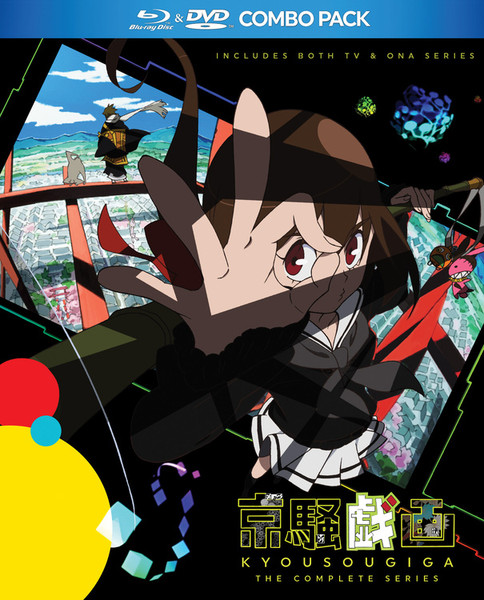
Kyousougiga and The Career of Director Rie Matsumoto

It says a lot when I can fall in love with a director after just one of their works. Rie Matsumoto stole mine and many others’ hearts after season one of Blood Blockade Battlefront. While at times her chaotic direction could produce scenes difficult to parse, I defend that she has a way of conducting a narrative unforgettably.

I’d always heard that there was one other show that she directed but I never got around to watching it. One day while walking through a movie store, I found a copy of a series that immediately caught my eye. Something about the art and its dynamic composition spoke to me and I thought it looked familiar. Sure enough, when I looked it up on my phone, there she was.

Kyousougiga, a Toho Animation series directed by Rie Matsumoto. Just recently I took the time to dive into it and get a sense of what an original work of hers looks like. Additionally, today I want to look at Matsumoto’s career past and present to get a better sense of her style and where she comes from.

Continue reading

What Do The Evangelion Rebuilds Do Better?

When you take an established property with a certain level of fame in the cultural gestalt and try to do it again, you are asking for criticism. Remakes have these nasty labels attached to them because in principal a worthwhile piece of art should be able to stand on its own. Why remake something when the old work still exists?

Apart from being a cash-grab, maybe to update art that is arguably out of date and hasn’t aged well. Better yet, perhaps the remake signifies an intention to take a work in another direction to use the original’s framing device in a new innovative way. Either way, it’s easy to divide people over a new vision. Too close to the original and it seems pointless, but too different and it could be seen as a betrayal.

But what happens when the same mind behind the original comes back to remake his work, albeit with new help? Hideaki Anno’s classic Neon Genesis Evangelion certainly gained fame over the years despite how infamous it was at the time. The psychological drama fueled by Anno’s anguish made it legendary and yet Anno felt there was more to be done.

Anno split off from Gainax and together with his underling, Kazuya Tsurumaki, he decided to “rebuild” Evangelion. These films have been praised and lambasted in equal measure over the years. Most often people find an issue with the lack of thoughtful psychological pathos that made NGE‘s characters so real despite the premise. You can find plenty who will praise the visuals of the rebuilds, but many who will argue it doesn’t make up for what is lost.

But is there nothing here of value? Are these films not without some quality that is superior to the originals? I like to think that isn’t the case and after finally watching them recently, I think there are plenty of reasons to fall in love with these films. With the fourth and presumably final film coming in 2020, now is the perfect time to ask, what did the rebuilds get right?

Continue reading

Bungo Stray Dogs: Season Three & The Art of Wide Appeal

Some months back I went on a whole tirade about finding my “perfect” anime and ended up determining my three favorite shows of all time. One of them was Kekkai Sensen, an episodic action series by Studio Bones, which remains to be the closest to perfection I have found. However, when making that decision, I had a significantly difficult time picking between that and one other show: Bungo Stray Dogs.

Bungo Stray Dogs follows the Armed Detective Agency, a group of superhuman detectives who keep order in the port city of Yokohama. Meanwhile, they frequently face off against other supernatural organizations such as the aptly named Port Mafia. All major characters are named and based on real literary authors.

They are somewhat similar in premise. Both shows follow a team of sometimes serious, sometimes whacky superhumans keeping the peace in their respective towns. Kekkai Sensen captures the packed insanity of New York City while throwing in aliens and monsters. Bungo favors a more comparably peaceful and modern Yokohama. Both shows are episodic with a through-line narrative, both straddle the line between dramatic and comedic and they are both produced by Bones.

Eventually, it was no contest that Kekkai Sensen won the battle for being a bit more put-together throughout, whereas BSD was mixed in the first season. It helps that the former has the single greatest season finale I’ve ever witnessed, putting at least the first season comfortably among my top three.

That being said, Bungo Stray Dogs rides much the same line that Kekkai Sensen treads in winning over my heart and could easily make my top 10. It has managed to continue strong, with a feature film and a currently-airing third season. Six episodes in, it doesn’t seem to be losing stride.

Continue reading

I Made A Video About Sakuga… Like… A Year Ago

So apparently I never shared a video that I made last year on YouTube. Or maybe I did and it was within another post. Either way, I’m sharing it now. I was taking a culture course to prepare me for my trip to Japan (where I currently am). It was the same course for which I wrote my review of Your Name (which oddly enough, I did share here). The story goes, I was asked to make a video about my host culture. Being a weeb, I decided to make a video about sakuga, as it is something I am deeply passionate about. Check it out below.

Continue reading

If Dolls Could Speak – Ghost in the Shell: Innocence

Ghost in the Shell (GITS for short), the acclaimed manga by Shirow Masamune, portrays a future Japan after a third and fourth world war that has advanced prosthesis to the point that full-body cyborgs exist. The series has existed in animated form ever since the classic from 1995 by Mamoru Oshii and each new entry has taken a different approach to utilize this world to talk about philosophy and ethics through the lens of a post-singularity world. There is one entry, however, that has been glossed over in the past, but which I believe to be criminally underrated.

This is my unedited essay on Ghost in the Shell: Innocence. This will contain spoilers for the film, so read at your own peril. If you would like the SPOILER-FREE review, click here.

Continue reading

Imagining My Perfect Anime

The “best” anime of all time is different for everyone. Across all media, in fact, you would be hard pressed to find a unanimously agreed upon “best” thing, outside of the agreements found within one’s own tight-knit group. Even then, there will be differences in taste.

“It’s all subjective,” is the point I’m trying to get across, but perfection doesn’t have to be dismissed in critique just because it’s improbable. If the perfect anime is different for everyone, and no consensus can be reached, then perfection is purely personal taste. It is absent of objective standards of quality and instead panders to the greatest amount of our interests.

I believe most people have not found their perfect movie or TV show, possibly because it doesn’t exist yet. We all have favorites though, so it stands to reason that if I took three of my favorite anime of all time and picked them apart, I could get a sense for what my perfect anime would be. Bear with me, this is going somewhere.

Continue reading

What the New ‘Ghost in the Shell’ Needs To Accomplish

It was reported back in August that Production I.G. would be going forward with two new seasons of the acclaimed sci-fi series, Ghost in the Shell. Not only that, directors Kenji Kamiyama, previously responsible for the amazing Ghost in the Shell: Stand Alone Complex, and Shinji Aramaki (Appleseed) would be directing one season each.

With this comes excitement but also caution. Ghost in the Shell is one of my favorite series and in my view, the best sci-fi franchises of all time. However, it would be an understatement to say I.G. hasn’t made some missteps recently. This year alone, we got B: The Beginning, a show I enjoyed, but that was terribly marketed and is already obscure. Who could forget the FLCL sequels, the first of which was god awful and the second of which I haven’t finished but have heard was decent.

Having directors like these on the projects gives me hope, no doubt, but I can’t help but worry that this will just be a lifeless cash-in like FLCL Progressive. Especially after Arise, the latest animated entry that was met with mixed reception, and a poorly received live-action film (Oh look, I wrote about that). GITS needs to get back to its roots and this new series might just be the chance for that, but this new story needs to be built on a strong foundation.
Continue reading

A Review of… Crunchyroll?

To the surprise of no one in this community, Anime is getting big. The movies, the exciting new projects, the growing fandom here in the states and the new players tackling this previously niche market are all very exciting. With this change though comes cynicism, as typical when the cool little clubhouse fandoms start as expand to cover more broad demographics and become something larger.

Subject to this vitriol recently has been Crunchyroll. The former illegal fansub site turned big streaming service has been growing for years, becoming one of the biggest names in Anime here in America. One that is lending a hand to the industry itself. Such growth is impressive and depending on who you talk to, really positive. Talk to the others though, and there is a different story.

Recent controversy mixed with my friends’ opinions regarding the service has given me pause to think critically about this company. Its quality as a streaming platform, it’s relationship with the Anime industry, and it’s own “agenda” (god I hate that word) are all up for discussion. So, as strange as it sounds, here is a review of Crunchyroll.
Continue reading

One Punch Man, My Hero Academia & Superheroes in Anime

It’s a criminal understatement to say that Superheroes are pretty big in America. The Marvel Cinematic universe alone has been releasing some of the highest grossing films every year since 2008, having released 16 films at the time of writing. Superheroes and what they stand for are integral to American pop culture. America isn’t the only country with superheroes, but it is safe to say it popularized them by creating some of the most iconic heroes ever made.

So it’s interesting what happens when artists from other countries craft stories about Superheroes. How do they view superheroes and what kinds of stories do they make about them? British comic artists like Alan Moore opt for a more grim take on superhumans in alternate timeline stories like Watchman or even in established properties like Batman: The Killing Joke. But recently, Japan has made a few Anime that have captured the superhero market of America in a big way.

One Punch Man by Studio Madhouse and My Hero Academia by Studio Bones are two of the most popular Anime of the last three years. Both produced by credible high-profile studios and both garnering a fair following in the US. The former a viral hit and the latter an ongoing shonen series that is essentially a textbook guide for how to do a shonen series right. On top of all of that, these shows are fantastic superhero stories.

There is a reason I chose to analyze these two series through the lens of superhero fiction rather than say the shonen genre like most people do. The most monumental difference I notice between these two Anime and superheroes in the west is that the government doesn’t just coexist with superheroes, but actively regulates and monitors them.

Keeping this in mind, what would it be like to live in the worlds of these shows or even be a hero in one of them? Are these societies and their systems stable? Most importantly, what do these shows do with the superhero genre that isn’t too common in American superhero fiction?
Continue reading

The Complicated Answer to “What Is Anime?”

What the hell IS Anime? Maybe you think the answer is obvious but the topic of the term’s application seems to be a heavily debated one. It makes perfect sense when we are talking about shows from Japan but in the same discussions about shows like Fullmetal Alchemist or Naruto, you could easily hear someone bring up American animated shows like Avatar or Voltron. There are countless arguments online as to the valid application of the term and just as many debating if the term’s use should even matter.

To me, the term “Anime” can be misused in a way that, by no intent of the person who misuses it, can paint a false image of Anime and perpetuate certain ideas about the medium of animation or the sub medium known as Anime. So today I want to lay out exactly what I consider to be Anime, how I rationalize this, and why I even give a shit.
Continue reading