Hey everyone, remember in 2019 when I gave Demon Slayer a 10/10?
Probably not, and that’s fine. I mean, I didn’t give it a 10 in the post itself, but that is what I gave it on MyAnimeList.net when I finished it, and honestly, I still stand by that. Season 1 of Demon Slayer was such a fun and jam-packed adventure that really hit all the right notes. Animation, music, performances, heartfelt themes – it had it all, and from when it began to where it ended, it truly felt like we’d experienced an adventure with only more on the horizon.
Fast forward to 2021, and I reviewed Demon Slayer the Movie: Mugen Train almost just as positively. It was kinda the first shonen anime film to prove that studios could feasibly continue the canon story through films rather than just making high-budget theatrical side stories that were dubiously canon at best. Mugen Train was awesome, and later, while writing for GameRant, I would go on to write about what I considered to be the most emotional scene, not only in that film, but in the series at large. That film rocked and made me even more excited for what the franchise held in store for the future…
… That is, until that future came. Now I’m just a bit sad.
In 2023, I asked, “Is Demon Slayer Losing Its Edge?” I’d recommend reading the article if not for the fact that, for some god forsaken reason, the website turned the word “shonen” into “shÅnen.” Whatever, I’m basically retreading the same ground here. See, at the time I wrote that article, I was wrestling with the fact that this franchise that I had once felt compelled to call “one of the best animated shows I have ever seen”, had fallen to the point where I was, of all things, bored. There hadn’t even been some kind of major creative shift in its production. It wasn’t a One-Punch Man scenario – it’s still the same studio, director, composers, etc. So, how did this happen?
Being the Popular Kid at the Shonen Lunch Table

At first, I wondered if perhaps this was an issue of bias, or more accurately, my perception of the art itself being clouded by the fandom surrounding it, but that’s never really been an issue for me. When anything reaches a certain level of popularity, there are going to be people who hate on it, either because it’s not to their taste, they’re tired of hearing about it, they don’t like the fanbase, they’re trying to be contrarian, or any combination of those elements.
I say this as a huge fan of My Hero Academia, which went through this exact process. By the time Season 3 was airing, the tide started turning, and suddenly, it was cool to hate on it, the source material, the author, and Studio Bones (which I will not tolerate). Funnily enough, it’s the same story with Rick and Morty on Adult Swim when the popularity of that show reached critical mass. And inevitably, if the quality of the art itself isn’t actually that bad, detractors lay the blame on the fandom, which can be understandable on a case-by-case basis, but more often than not feels like a lack of personal responsibility.
Let People Like Things and Whatnot
Let me explain: If (insert title) is one of the most popular shows in the world, that means a statistical fuck ton of people are probably watching it. That might seem obvious, but you’d be surprised how often detractors of popular things forget that “a fuck ton of people” naturally includes people whom they might personally find annoying. And what qualifies as annoying spans a collection of demographics as vast as the human population itself. It could mean genuinely toxic people, but it could also just mean teenagers or people who just like things in a way that could be perceived as cringeworthy, as if any of us aren’t guilty of being cringe over something we love.
It’s an irrational impulse, but it’s also an understandable one, born from a combination of emotional factors, especially a fear of missing out. I stopped watching Stranger Things after the first season (a season I loved) and never got around to watching more, but I feel weirdly and undeservedly critical of that show’s longevity when it’s getting hyped up, because I’m out of the loop. There will always be things that are popular and agreed by the majority to be (for the most part) good that we will individually be bitter about because we aren’t on the bandwagon or because someone we find annoying won’t shut up about it.
Cut to the Chase, Old Man
I bring all of this up because I can confidently say that I am NOT displeased with the Demon Slayer fandom. I have no issue understanding what its fans, especially younger fans, see in this series, because I felt the same way watching Season 1 and Mugen Train, and felt flickers of that same love during the heights of Seasons 2 and 3. There might be deeper and more compelling stories in the medium, captained by leading characters with more depth, but few shonen I’ve seen express themselves as loudly as the Demon Slayer does.
This is my effort to find a common ground with any hardcore fans that might be reading this before I take off the gloves and go in on why this series irritates me. Because I promise you that anything negative I have to say about this series is only out of love for what it used to be. I genuinely believe Demon Slayer has only gotten worse since Mugen Train, and all because the storytellers have taken a once brisk and expansive adventure and ground it to a crawl.
Mugen Train Changed Demon Slayer Forever

Back in 2021, the idea of taking a smaller arc and turning it into a movie rather than waiting to adapt it as part of another season was low-key groundbreaking. Seeing anime get bigger on a global scale has already warmed my heart, but to see it work side-by-side with the film industry, filling theaters for huge tentpole events, is even more exciting. Especially considering the vocal push to support and revitalize the film industry and the moviegoing culture, Demon Slayer helping to get butts back in theaters after the quarantine was big.
After Mugen Train, two things happened: first, the movie was re-edited as a seven-episode event for TV, and second, the 11-episode Entertainment District Arc began airing in late 2021. I eschewed the TV edit of Mugen Train, but when I finally got around to binging the new arc, I was entertained. At least, I was by the end. The first half of the arc was a bit slow and mostly relied on Tanjirou and the gang goofing around in disguises and investigating the demon they were hunting. Afterwards, though, the entire second half was one huge city-spanning battle.
The Highs and Lows of the Entertainment District Arc
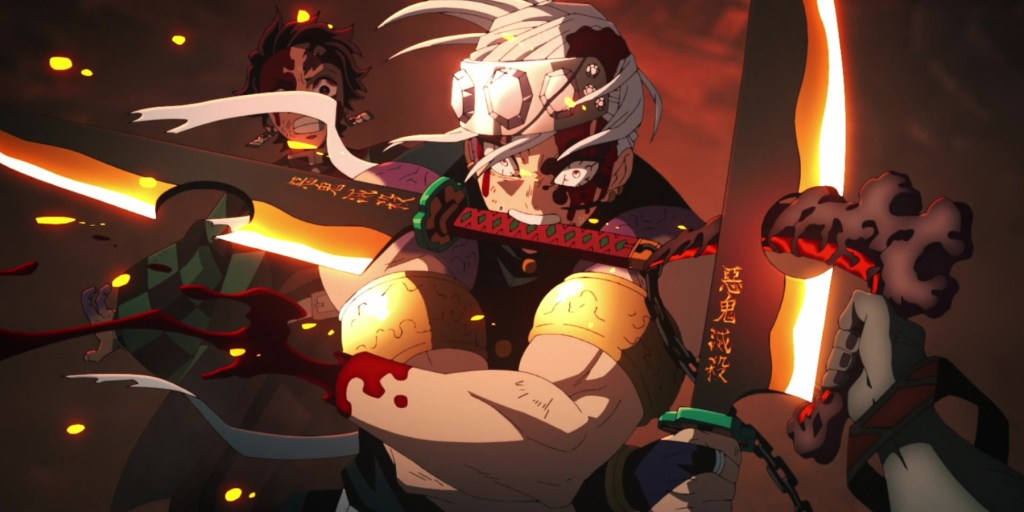
I’m not going to spend a lot of time talking about the ins and outs of the animation, because I think it’s safe to say it’s pretty spectacular. Ufotable is popular for a reason, and that is their command of digital effects work blended with traditional hand-drawn animation. I really enjoyed the demon of the arc, as well as the surprise reveal of her brother, who ends up being the real final boss. Once again, the storytelling managed to pull my favorite trick, which was making me cry over the villains’ backstories, no matter how despicable they were before that point.
Any boredom I had in the early episodes was more than abated by the time the credits rolled, but I still felt like something was missing. It didn’t leave me as excited as Mugen Train, and despite being 11 episodes long, it didn’t feel like Season 2 covered nearly as much ground as the same number of episodes in Season 1. Additionally (and this is just me), I found Tengen a bit annoying, and his three wives even more annoying, but then again, I find most of the Hashira to be uninteresting.
By the time Season 3 was announced, I realized that I never really got “Season 2”, just “the next arc,” and that was the key distinction to understanding what was different about Demon Slayer. They weren’t making seasons; they were making arcs, arcs that were relegated to mostly one location with a limited cast of characters and antagonists. And on its own, that’s not a problem; it’s just a different narrative framing, but in the grand scheme of this series, it is a problem, because Demon Slayer thrives in motion and struggles standing still.
The Problems with Demon Slayer (The Ones You Don’t Care About)
The cast of Demon Slayer is not that deep. They’re one-note, one-dimensional, and don’t evolve that much between the beginning and the end of the Hashira Training Arc.
The catch is, I didn’t know (nor did I care) about that in Season 1.
Why? Because the storytelling was really good. It did not linger in one place long enough for you to think about how deep and complex the characters were, and I don’t consider this a flaw; It’s a feature. Season 1 was emotion-driven, letting the artistry articulate everything the written word couldn’t, and the result was great action and impassioned dialogue that was carried by the performances and music. More than that, it was the way antagonists hounded our heroes until they finally found the ground from which to counterattack and claim even the slightest victories.
There’s a reason people still remember Episode 19 of Season 1 as legendary, and it’s because it felt like the culmination of everything depicted up to that point. Hearing Nezuko’s voice, her activating her Blood Demon Art, Tanjiro using Hinokami Kagura, and that spider demon bastard getting beheaded by a broken sword of all things, were all perfect. More than anything, it was earned because we spent what felt like years with these characters, yet without barely a second of it feeling like a slog.
Demon Slayer Can’t Hide Its Problems Anymore

I’m not gonna sit here and pretend that this series isn’t still capable of delivering powerful, emotional moments. The end of the Entertainment District Arc and the climax of the Swordsmith Village Arc are both well produced, but the weight of these moments felt less to me because of how meandering these arcs were as presented. I would have much rather preferred that the Entertainment District Arc, Swordsmith Village Arc, and especially the Hashira Training Arc were all just one big second season, but with each arc trimmed down somewhat to keep up the momentum.
Frankly, the fact that they were released the other way feels less like a creative choice and more like a way to milk the franchise for all its worth. Why make only two seasons when you can technically make four over the course of six years, plus a movie? And hey, that’s not even counting the upcoming film trilogy that’s gonna wrap everything up. Is it a surprise that the production committee would want to capitalize on success? No, but it could have been capitalized in other ways that didn’t compromise the quality of the story.
Demon Slayer’s Pacing Hurts Its Cast Most of All
As it stands now, Demon Slayer is a frenetic action shonen, but one lumped with the pacing I’d sooner expect from Ufotable’s Fate/Stay Night Heaven’s Feel movies, which have a noticeably slower pace in service of its darker, more character-focused plotting. The trouble is, as I stated earlier, the characters in Demon Slayer aren’t that deep and don’t develop that much. Now, I can’t understate how much this didn’t have to be a big problem, but considering what we’ve gotten since Season 1 ended, it’s hard to ignore just how underwhelmed I am by the cast.
The Swordsmith Village Arc felt, to me, like the nail in the coffin for the characterizations. Zenitsu and Inosuke, who are two-thirds of the main trio, are absent from the arc… in a genre where the main trio is often incredibly important to the iconography of a given story. And it’s not like either one of them had received much character development up to that point anyway, nor would they receive much more in the Hashira Training Arc when they returned.
Seething About That Joke of a Fourth Season
Let’s talk about the Hashira Training Arc because I have never seen a mere eight episodes of television try my patience more. I stand by every reviewer who had the stones to give this season a low score despite the inevitable, and I stand by the 4 out of 10 I gave it on MAL. Having a training arc is one thing (those can, in theory, be fun), but the fact that it is the penultimate arc of the series, the one before the film trilogy that will end everything, makes it so much worse.
Eight episodes don’t sound like much, but it should have been even fewer. Conceptually, there’s an opportunity to explore the Hashira and deepen them as characters, specifically the ones we haven’t learned about yet, but it only bothers to develop like two of them: Giyu and Gyomei. For that matter, Giyu’s backstory was the only one I felt much attachment to, because it subverted the idea of his character compared to how he had been presented from the start. As for the rest of the season, it was mostly watching characters train in between goofing off. And then Muzan shows up at the end and sends everyone to the Infinity Castle. Riveting.
Am I Being Too Harsh?
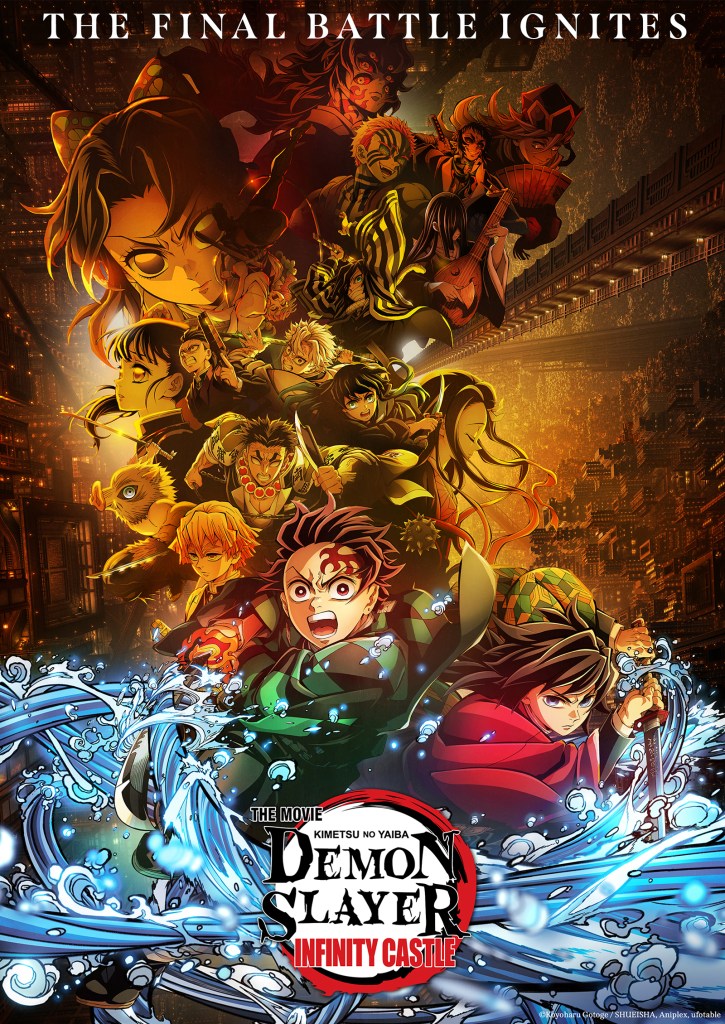
Probably. I’m sure some people loved it and were there for the vibes. I guess I just expected that after six years, I’d feel closer to more of these characters beyond knowing a few more details about their backstories, or that more had been accomplished. That’s a lot of years for a franchise to be consistently active and yet feel like it hasn’t moved an inch. By comparison, Jujutsu Kaisen had two seasons and a movie in half of that time, and it feels like way more happened. I expected Demon Slayer to feel bigger by now, but instead it just feels smaller.
I remember watching Tanjiro in Season 1 walk through the more modern-looking cities of Japan’s Taisho period, and feeling second-hand culture shock. I remember thinking that the setting was such a smart choice, what with the clashing of tradition with innovation, and how the battle with an ancient enemy felt all the more appropriate in a time of transition like this. By Season 4, I had forgotten the setting entirely, because so too had the story lost all interest in how the era could/would influence it.
That same season, I remember finding Giyu so mysterious and being excited to learn about him. I recall when Shinobu nearly killed Nezuko, and Giyu was placed in the awkward position of trying to defend a demon. There was so much suspense in that one act that spoke to what would be an ongoing struggle to advocate for Nezuko’s right to live, and I was captivated by the Hashira. Now, though, I find Giyu, most of the Hashira, and the Demon Slayer Corps as a whole to be boring.
Why All Hope Is Not Yet Lost
A lot of my complaints have been rooted in the pacing and structure of the anime, but there’s a sense of finality in how I tend to talk about this series that I fully acknowledge is premature. Demon Slayer‘s final arc is approaching, but just because it’s the “final” one doesn’t mean that it will be short by any stretch of the imagination. So long as there is time before this story is truly over, there is room for improvement. For that matter, as I’ve recently learned, the “final arc” is technically two arcs, the latter of which might very well be the last of the trilogy.
Across a trilogy of films, there is more than ample opportunity for character development, explored through this franchise’s thoroughly established penchant for spectacular bloodshed. From the trailers released, I can already tell we’re going to get some development for Shinobu, who is seeking revenge for her fallen sister. Plus, if what I’ve heard and inferred is true, we might finally get some more development for Zenitsu and Inosuke.
Yay.
I hope my enthusiasm wasn’t too infectious there.
Let Me Try That Again
Dammit, I’m sorry, I’m being a little shit again. Believe me, I am excited for the Infinity Castle movies, and I’m more than willing to give this series another chance, but I’m just disappointed that I’m not more excited. Even if these movies bring this series to an incredible close, there’s gonna be plenty of waiting until it’s well and truly done.
Furthermore, the greatest finale won’t change the multiple years of underwhelming disappointments that bogged down what once was a new instant favorite of mine. That being said, if Demon Slayer The Movie: Infinity Castle exceeds the hype and genuinely fills me with the same joy that the past three seasons have steadily eroded, I will be more than happy to come back here and proclaim as much. Until then, I’m sorry to say that Demon Slayer has kinda been a big disappointment since Mugen Train.
Demon Slayer is streaming on Crunchyroll.
If it wasn’t obvious, this was basically me covering my bases on the old blog before the new movie comes out. You can expect a review soon.
Come to think of it, there’s a lot of stuff I’ve written about on this blog and even more that I wrote for GameRant, in which my more contemporary views on the industry are platformed. I’m extremely proud of the stuff I wrote there for nearly three years, but since I love this blog dearly, I want to take the opportunities once in a while to expand on some of those pieces. Additionally, I’d like to think I’ve become a better writer over those three years, so it would be a waste to not make this blog more reflective of my skills now. Plus, some of the early pieces on this blog have certainly shown their age.
Anyway, thank you very much for reading.
Stay healthy, stay safe, and as always, I’ll see you in the next one.
 Sakura Sunrise