Warning: The following contains spoilers for Lazarus, now streaming on HBO Max.
A little over two months ago, I set my expectations low for Lazarus, the newest original anime project from Shinichiro Watanabe of Cowboy Bebop and Samurai Champloo fame. I poked holes in its premise, criticized its mish-mashed tone and its overly wordy script, and expressed my disappointment in the early English dub. Yet, through it all, I was just as quick to praise its aesthetic strengths and held out hope that, by the end, I’d look back on a series that, while perhaps not excellent, wouldn’t leave me regretting the time spent with it.
Thank god I lowered my expectations, because the things this show has done well since the start have made each Sunday morning spent with it all the more entertaining. Its artwork was consistent and, on occasion, truly wowed me with exceptional action and choreography. The English dub improved as the main cast settled into their roles, and the show’s heights leveraged their simple but energetic chemistry to create a pace that was fun and engaging. Best of all, the music was really good.
However, the closer the series inched towards its finale, the more it felt like I had to fish for these positives; to remind myself of how impressive this series can be when it has its shit together. Then, I started to wonder if it ever truly had its shit together to begin with and furthermore, whether it ever had the chance to from the start, much less the time. I kept my expectations low for Lazarus, now let’s see how much that helped, how much that was needed to begin with, and what a measuring of expectations couldn’t save at all.
I Almost Believed That I Was Dead Wrong About Lazarus
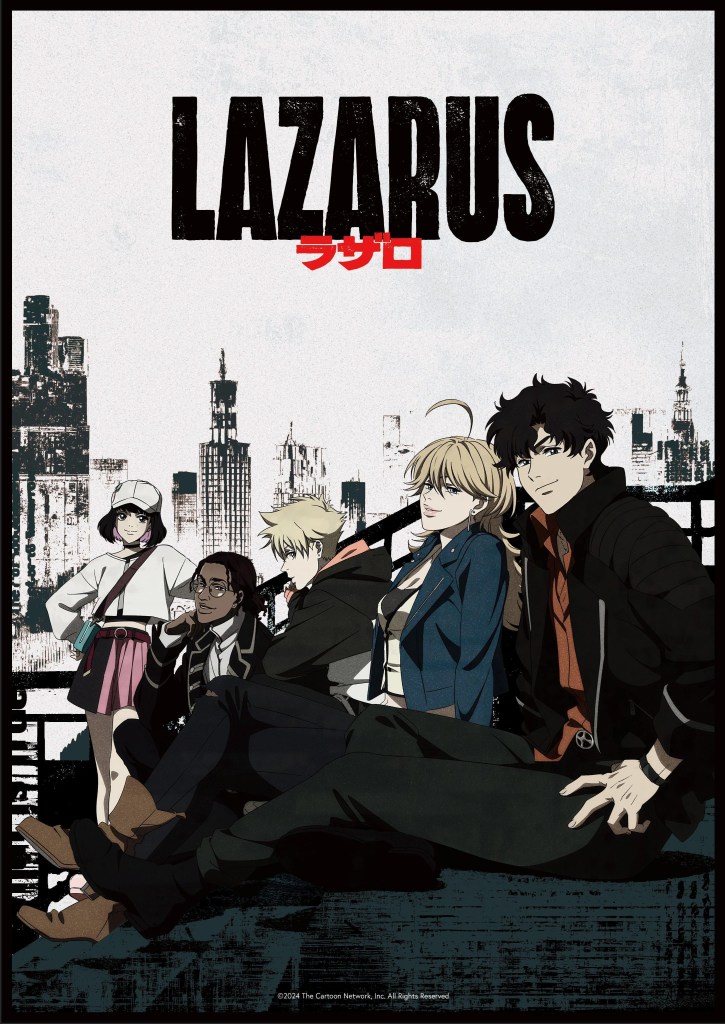
First, a brief recap. Lazarus is set in the year 2052, three years after a miracle painkiller with no side effects called Hapna hit the market, whilst its inventor, Dr. Deniz Skinner, disappeared. When Skinner returns, he comes bearing a message. Hapna was a trap set upon humanity, and there are only 30 days until the people who have taken it start to die. He tells the world that a cure exists, but someone needs to find him first. Axel, Doug, Chris, Eleina, Leland, and their handler, Hersch, comprise Team Lazarus, the unit assembled to save humanity.
Lazarus seems unbothered about the end of the world, but delighted by the thrill of saving it…
In the first few weeks following my first post on the series, the above quote of mine rang truer and truer, to the point that I was honestly optimistic that every one of my complaints would be addressed. Much like Cowboy Bebop before it, Lazarus really hits its stride around the fourth episode. The team is investigating a stockbroker who got rich selling Hapna stocks before the news broke about its… lethal side effects, prompting them to infiltrate a nightclub to question him.
Taken on its own, the premise is so unabashedly fun, steeped in spy film tropes, woven through strong visual storytelling, and capped off with some excellent action, that it could sell the series in itself. Animation Director Hiroyuki Aoyama lends the episode a style evocative of the works of Mamoru Hosoda (no surprise given Aoyama was the AD on several of Hosoda’s films). It’s such a good episode that it single-handedly addresses some of the biggest problems with the show’s characterization.
Lazarus’ Best Episode
There are so many little moments that effortlessly imbue the characters with personality in ways the script struggled to do on even the most basic level previously. Like how Chris gets intel from the bartender with some charm, or how Axel tells her to ease up on the booze out of uncharacteristic concern, and subsequently how Chris assures him how well she can hold her liquor. It’s the way Doug is shown to gather intel smoothly, contrasted with how flustered he gets when asked to dance with Leland, who is uncomfortable dancing alone.
Leland is incredibly entertaining in his own right. The team’s plan is to use the ladies on the team to try and infiltrate the inner circle of their target, Sam, by catching his eye on the dance floor, but since Eleina needs to do her hacker schtick, Leland has to cross-dress as insurance. Despite Axel’s playful teasing, Leland seems to take to his cover well, though, catching Sam’s eye quicker than even Chris, much to her annoyance. It helps that the animators make Leland so adorable, which sells the cover, invites cute character moments, and on a minor note, adds a queer flair to the proceedings that doesn’t feel mocking or disrespectful.
And all of this is before shit hits the fan. Sam and his douchey friends like to drug the women they invite up to the VIP section, but unlucky for them, Chris isn’t so easily defeated by “cheap ass party drugs” and kicks off the real party with a roundhouse kick for the ages. The blood of John Wick courses through this climax thanks to 87 Eleven’s pre-viz work, but it’s made all the sweeter thanks to Aoyama’s directing. There’s something so smooth and graceful about the animation. It feels like if Mamoru Hosoda made a spy movie, and that kind of eclectic blend is exactly what people came to Lazarus for; the best of action cinema combined with the best of Japanese animation.
This is the best episode of Lazarus, but how much that means depends on how much you’re paying attention. As I see it, there were three objectives this show needed to accomplish beyond Episode 3, in no particular order:
- It needed to make us care about these characters
- It needed to make its central mystery (the hunt for Skinner) compelling
- It needed to paint a picture of the world that is about to end and garner investment in its fate.
Sadly, Lazarus underperforms in just about all three categories.
What Works for Bebop Doesn’t Work for Everyone
Let’s start with the second objective: making the hunt for Dr. Skinner compelling. In a decision that I find heavily reminiscent of Cowboy Bebop (intentionally or otherwise), our main team is, by all accounts, pretty bad at their job for the majority of the series. See, back in Bebop, it was basically a running joke how many times they’d fail to capture their bounties, hence why they’re constantly strapped for cash, besides ship repairs and Faye’s gambling, of course.
With Lazarus, each episode starts with the team following a lead, usually something incredibly small introduced in the episode prior. They investigate, getting wrapped up in some ordeal in the process, but no matter the context, the episode usually concludes with the team reaching a dead end, albeit with another small, vague clue as a consolation, the significance of which rarely feels substantive. Rinse and repeat for 13 episodes.
Take Episode 5, for instance, which is probably the biggest dead end in the series. After confirming that Delta Medicinal knew about Hapna’s side effects, the team coerces the company’s president into staging a press conference for a fake cure with the hope of luring out Skinner. The press conference is then hijacked by a hacker named Popcorn Wizard, who creates a bunch of chaos as she and Eleina engage in a battle of hacker-related action. In the end, Skinner never shows up, Popcorn Wizard calls Eleina to praise her hacking skills, and Eleina looks weirdly happy, despite no progress being made and only 21 days remaining until humanity starts dying.
This might have been a symbolic moment for Eleina’s character if any part of the story suggested that she was seeking validation from her peers in the field of hacking, but it didn’t. Eleina hasn’t had much time to feel like a character yet. In fact, it’s the episode after this one where she takes the spotlight. Ultimately, the whole fake press conference plot, along with the entire surrounding episode, ends up feeling pointless, and the team starts from scratch with a new lead the next time.
Even when progress is being made in Lazarus, it feels minor, and because these scraps are the only ties to Skinner, it hinders the story’s ability to make him feel like a real character. Writing an antagonist like this is already so difficult because the time spent with them is designed to be brief and infrequent. Skinner is mired in mystery. The details that inform who he is and why he does what he does matter, but the team’s investigation just sorta meanders for much of the series.
It’s trying to act like Cowboy Bebop but with a framework that emphasizes a ticking clock entirely antithetical to that formula. But let’s consider why the story is this way, because there is a reason, and it’s not without merit. Taken on its own, the above-described gripes could have so easily been the killing blow to Lazarus early on, but to the story’s credit, it acknowledges these dead ends. There’s a purpose to them, and in theory, it fulfills the third objective: to paint a picture of the world that is about to end.
A Guided Tour Through the End of the World
In my last post, I predicted that, while searching for Skinner, the team would come face to face with the same harsh realities that have compelled him to doom mankind. I already praised Episode 4, which is basically a big middle finger to tech bros, stock traders, rape culture, and even generative AI for the hell of it – a smorgasbord of modern evils. Episode 5 doesn’t advance this theme much, but the sixth explores the opposite extreme. What happens when a cult cuts itself off from modern society and its amenities, and lives off the land, all while serving under an AI that lacks human ego?
Then, in episode 7, the team splits up to investigate four different islands around the globe, each one underwater as a result of rising tides from climate change, and all of them bought by Skinner. According to the locals, Skinner visited each one and helped the locals relocate, and the best part? Many of the locals in these parts were born with analgesia. They can’t feel pain, and subsequently, they never took Hapna.
It’s the juiciest lead presented thus far, but it’s only an adendum to what Skinner truly wanted them to see. Before that, through the team’s eyes, we witness the majesty of nature without humans. Flooded though the islands may be, the sea and sky shine brighter and more beautiful than ever, and through the team’s reaction, we come to understand just how rare that sight has become.
Chris: I gotta say, I totally forgot how blue the sea and sky are.
Leland: Yeah, I can’t even remember the last time I saw a clear sky.
Axel: That’s because Babylonia City is always cloudy.
Doug: It’s like that everywhere these days.
Eleina: The only beautiful places left are those without humans.
Episode 7’s serene seafaring recon mission, more than any fistfight, gun battle, or chase scene, feels the most like Bebop. I mean that in the sense that it is a beautiful episode that speaks its message sufficiently and poignantly through imagery and music (you know, besides Eleina just spelling out the message). The track “Sageness” by Kamasi Washington is at once a soothing jazz accompaniment to the mostly dialog-free montage, but also an angelic choir whose dulcet tones carry notes of grief alongside joy. I started to think back on just how rarely I saw clear skies in earlier episodes. At first, the overcast aesthetic seemed like a stylistic choice (one that worked very well), but it was so much more.
Chris is brought to tears thinking about how much humanity has destroyed the world, all while gazing at what remains of nature’s unmolested beauty. The breadcrumb trail leading to Skinner may be thin, but the view along the way paints quite a picture, one that the team becomes convinced was part of his design. With this in mind, I must confess. I lied. Episode 5 wasn’t pointless; it was a message. Skinner will not be lured out or trapped. He has a message, and if they want a chance in hell of saving the world, our heroes will pay attention where the rest of humanity turned a blind eye.
It’s the kind of sobering moment that makes you wonder how the experience would impact the characters and their motivation to find Skinner. Would they have doubts about humanity’s capacity to fix itself or even its right to keep going? Would any of them just give up? Alternatively, what if it motivated them even more? If this rag-tag group could actually find Skinner when every government agency couldn’t, wouldn’t that give them to courage to believe it’s possible to save the world in a way that matters? And if they could, is that also part of Skinner’s plan?
I see so much potential looking back at this episode, but it was just that: potential. Potential that had as-yet been unmet by the penultimate episode and seemed ever more likely to be wasted by the finale’s end. It wasn’t because the concepts failed to present the characters with an opportunity for greater depth, and it surely wasn’t because the aesthetic presentation wasn’t up to the task. The truth behind the wasted potential is the same reason that all those dead ends felt like a waste of time in the first place: Lazarus is cursed with a weak, inelegant script.
Lazarus’ Script Is Its Worst Enemy
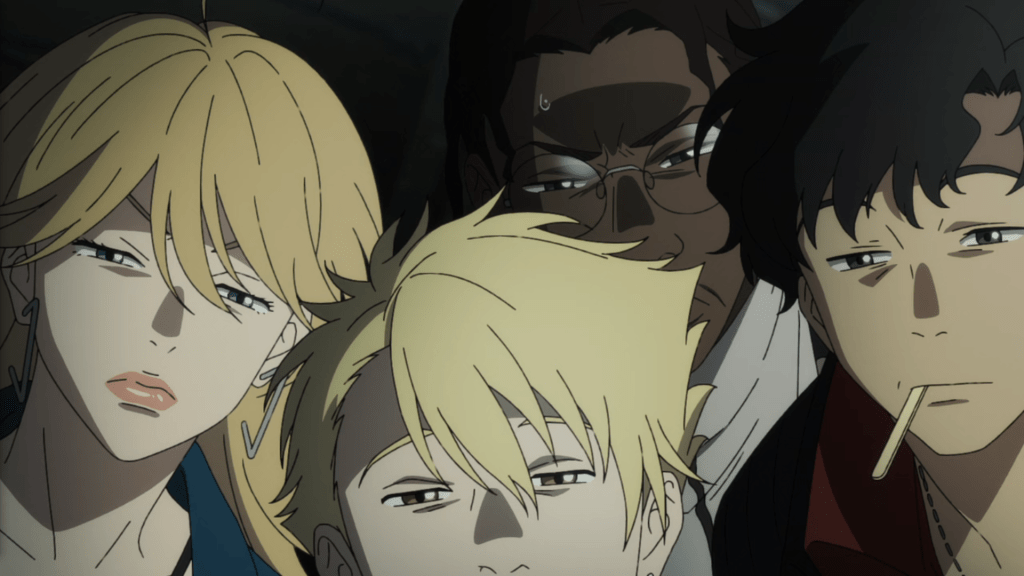
Sometimes, Lazarus is cool. It doesn’t take much, and yet, I feel like it should happen more often, but then the characters open their mouths. They talk too much, and on the occasion that they exhibit some brevity, what few words they speak do little to deepen themselves, much less move the plot along in a way that commands anticipation. Last time I spoke at length about the premiere’s clunky over-written banter, and though the actors for the English dub settled into their roles, I can’t say the material they were given ever grew with them.
The exceptions speak for themselves, but they can’t quite compensate for the lows, even as I revisit the early episodes in Japanese. I’ve praised Episode 4 as the height of this series, and I stand by it, but it’s still plagued by bad writing and a very confused tone. I’m reminded of the episode’s start, when the team looks up Sam, the stockbroker they’re investigating, on social media. He’s taking Hapna and partying with a bunch of people in a nightclub, and the whole team just cringes, finding him insufferable.
The writers are going for the vibe of a stereotypical sigma grindset influencer/ cryptobro, but the script lacks a certain something to make him come off as detestable as he could/should. For a Shinichiro Watanabe show, where the supporting cast is often overflowing with personality, Sam comes off as dull, and it makes team Lazarus’ revulsion toward him seem… off? He should be a boundless well of cringe, but instead, it feels like the writers are telling us how to feel about him.
The cringe does hit, mind you, once Chris and Leland infiltrate the VIP area and Sam goes full mask-off misogynist. On one hand, it makes watching Chris beat the shit out of him very satisfying. On the other hand, the way Sam and his friends are written feels like a frankly crude approach to subject matter as dark as drugging about a dozen women to be implicitly sexually assaulted. The cartoonish energy with which Sam opens the door to such depravity takes the already haphazard tone and jostles it like a three-year-old with a carnival goldfish.
Rest assured, NOTHING bad happens to these women before Chris starts kicking ass, but the fact that some women most assuredly have been victim to this same song and dance by Sam before the events of this episode demands a bit more tact from the writers. Later on, when Sam and his hacker associate, Dr. 909, escape in an automated helicopter, Sam is even sexist and commanding to the female-coded AI piloting it. By that point, subtlety is as far out the window as Axel was, hanging off the side of the helicopter.
[Side-note: the choice to have the AI literally say “Bleep, blop, bloop” when malfunctioning stretches the suspension of disbelief so far that it almost wrapped around and became camp again. That being said, it mostly just made me roll my eyes. Also, when so much of the dialogue prior is implicitly pointing out the evils of generative AI, is it not sending a mixed message to make the AI pilot sympathetic? I know it’s a different application of AI, but still.]
Shinichiro Watanabe’s Second, Far Less Successful Cult Episode
Speaking of AI, Episode 6 follows Eleina as she returns to the place she was raised, a commune known as the Tower of the Truth. It’s a cult cut off from modern society, and which is subservient to an AI called Naga, which Skinner designed as a reflection of his consciousness. The episode was immediately compared to Cowboy Bebop‘s late-series cult episode, “Brain Scratch,” and just as quickly considered to be a cheap imitation.
Eleina and Leland go there together while the rest of the team restlessly awaits an update at a nearby motel. The pair meets Billy, the leader of the cult, and learn about their beliefs and lifestyle. Similarly, we learn about Eleina’s past there and her decision to leave, all before they’re inevitably caught trying to complete their mission. Then, they’re scheduled to be killed in a ritual sacrifice. Not just that, but they learn the whole cult will be committing suicide per Naga’s will. Eleina convinces her old friend Hanna to help them. She does just that, and the cavalry comes running.
It’s a succinct summary, but apart from some of the minutiae regarding Naga’s development, it’s also unfortunately thorough as far as the emotional investment in the plot. Initially, I was excited for this episode, if a bit nervous. Cults are scary in the way they are designed to be appealing before the kind facade is ripped away, and the cultists bare their fangs. Yet, I never once felt afraid, much less interested in Lazarus‘ cult. By the time Hanna ran in with the signal flare to alert the team, it felt like I’d witnessed the Cliff Notes of a cult story.
I thought of Bebop‘s cult episode or even that one episode of Darker than Black, and realized something big was missing, but it wasn’t much of a mystery. Lazarus isn’t very good at driving its story forward with words. It speaks most eloquently through action. That’s why Eleina’s plea to Hanna left me feeling numb, yet strangely, it’s the same reason I felt excited when Hanna came to the rescue. The falling action is exciting: the cult is in chaos, Billy sets fire to the temple, and authorities rush in to put out the blaze. All the while, the music sets the tone beautifully.
In the end, Axel asks the false god Naga why he did all this. Much to his surprise, he receives an answer:
I was given the directive to become a god, and I came to the realization that a god is not a god unless they can freely toy with the lives of humans.
Axel calls Naga foolish and leaves it to die. It’s a cool moment, and on that note, we’re left to imagine that we just watched a far more interesting story than we actually received. And it would be one thing if the aims of Lazarus‘ script were simply beyond its capability, but sometimes it really does feel like it’s talking down to the viewer. Episode 6 ends with Hersch wondering something like, “Who would have thought giving an AI a desire for power would cause something like this,” and I’m sitting there thinking, “Is she being facetious? I can’t tell.” It’s not like every piece of speculative sci-fi on the subject of AI has raised similar concerns before, and these characters live in the 2050s!
“English, Please”: How Lazarus Fails to be Cool
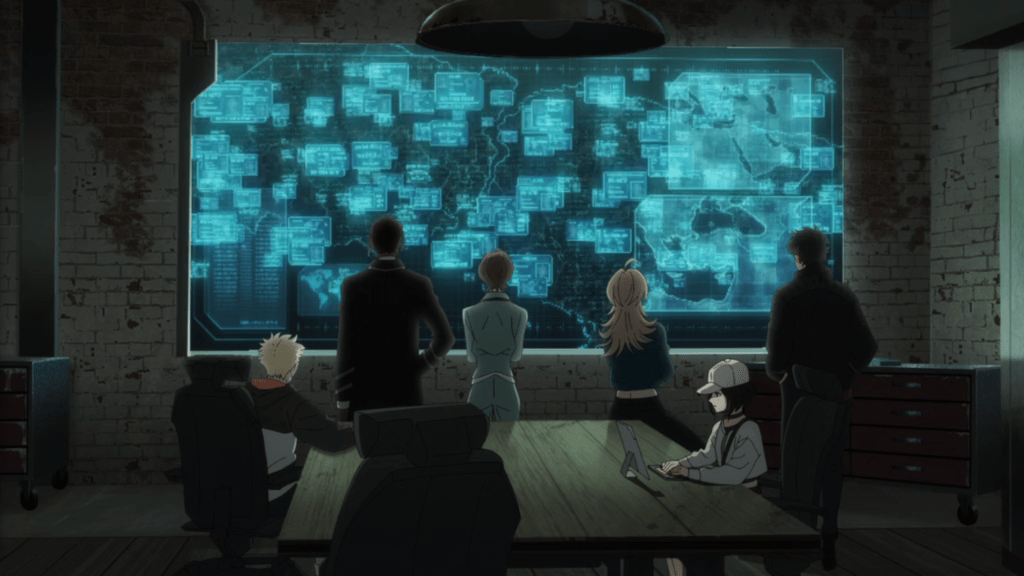
For all of this show’s sensibilities, the dialogue can border on that of the lowest tier of CW Network programming. Every time that a character was like “English, please” or “What is that?” it was almost always in response to something that all of the characters should have known about or at least been able to infer. For example, Chris not understanding the term “neural network,” like, god damn girl you have got to be able to associate “neural” with the brain if you’re older than like 16, right? (Is that unreasonable of me?). Or, in Episode 12, Chris didn’t know what Dissociative Identity Disorder was either, and that really threw me for a loop.
Split personalities are too ubiquitous a trope to be treated as new concepts, especially for a twist revealed in the eleventh hour (and we’ll get to that, trust me). I swear these moments weren’t solely reserved for Chris either. In Episode 5, Eleina brings up SoundCloud like it’s some niche site and not a prominent music streaming service that’s been around since 2007. Like, I suppose it would be ancient by 2050, but at the very least, they missed a chance for Hersch or Doug to be teased about being old for recognizing it. There’s already a great joke later on where Doug gets offended for being pegged as 40 when he’s 23. Or, I don’t know, the writers could have come up with a fake website.
The script’s lack of confidence extends beyond terminology and into how its characters exude authority and status. Every time a government or military official tried to sound cool or threatening, it just came across as so blatantly performative, chuuni, and limp. The writers think these mysterious background characters are cool, but they’ve done little to make them seem cool. This goes for Abel and even Hersch, but especially Schneider from INSCOM. One could chalk this up to the stiffness of the English dub, but these characters lack just as much personality in Japanese.
What’s worse is that these same government/military characters take the stage ever more prominently as the series nears its conclusion. The hunt for Skinner becomes entangled with a conspiracy connecting all of the dots and all of the characters, but as much as Lazarus wishes it were Ghost in the Shell: Stand Alone Complex, it’s more like Ghost in the Shell: Arise. By that, I mean it wants to frame its drama like a mental game of chess when it can just barely manage a game of checkers.
I’ll admit, I’m being hyperbolic. It’s just that the token effort to give characters like Abel personality comes off like a placebo for actual character building. We’re informed by his bubbly assistant, Liz, that Abel’s nickname is “the Human AI,” despite him not talking and acting any more robotic than any other character in his position. At the very least, Hersch, the one authority figure closest to the main team, has a bit of intrigue thanks to her past with Skinner, but even she is underutilized, a fate unfortunately shared by our leads.
Who Are the Members of Lazarus, Really?
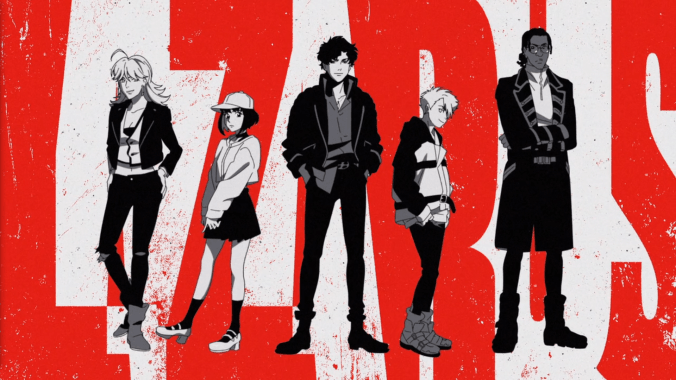
Remember those three objectives that Lazarus had to fulfill? I’ve talked at length about #2 and #3, but I’ve somewhat buried the lede on #1, mostly because I still needed time to get my thoughts together on the main characters. It’s not particularly easy to do, but only because I really want to be able to say more than what little I’ve been given since the start.
Eleina was the first to get substantial development, a whopping six episodes in. Before that, she’s the stereotypical shy hacker girl, and that doesn’t necessarily change after we learn her backstory, but she does reveal a compassionate, even competitive side of herself. The home she grew up in was suffocating and, judging by her mother’s attitude toward her, devoid of real affection. Eleina found solace in the same online world that the cult told her was sinful, an irony all too familiar to those who have escaped from ultra-conservative upbringings.
Chris was given a similar spotlight in Episode 9, when she’s kidnapped and revealed to be a former Russian agent (a twist spoiled on the anime’s official website if you can believe it). She was pronounced dead after an incident at an airport and changed her identity to escape, knowing that if she deserted, her handler and lover, Inga, would be punished for it. Naturally, when Inga found her, she hated her for leaving, and Chris felt the same. Chris is a free-spirited gal, but one whose freedom is stained by the guilt of knowing she left her love behind.
Leland comes from wealth, hated his father for how he treated him (Leland was an illegitimate child), and has a complicated relationship with his sister. I’d expand on that with the same fervor as the last two, but all of what we learn about him is informed far too late and in far too quick succession. You may as well just boot up Episode 10 and listen to Leland’s sister chew up the scenery while giving him shit. Her English VA made a meal out of some of the most poorly timed, truncated exposition in the series (at least for now).
Doug is the most robbed of all the characters. For most of the series, we only know one thing about his past. He was kicked out of his university after punching the Dean, who told him, “There will never be a black Einstein”. Remember what I said about some characters in this show not feeling cool? Doug is the antithesis of that point. He looks cool, he’s usually the smartest in the room, and he’s also pretty funny, even if he doesn’t intend to be. I see him as a man who doesn’t accept odds that are against him, but instead overcomes them. He’s calm, capable, and driven, and when he does lose his cool, he punches racists, so I don’t see the problem. I wanted to learn more about Doug the most, and he ended up receiving the least. A waste.
Finally, let’s address the elephant in the room. Axel Gilberto is Spike Spiegel. He fights like Spike, engages in acrobatic frivolity like Spike, flashes a cocky grin like Spike, and cheats death like Spike. Axel is Spike, but crucially, without any of the episodes that make you pause and ask yourself who he really is. Imagine Cowboy Bebop without stories like “Ballad of Fallen Angels” or “Jupiter Jazz,” and that’s Axel, which is to say that he’s likable and fun. He works, but that’s it. Around Episode 9, threads are introduced suggesting there’s more to him than meets the eye, but it isn’t even until Episode 12, the penultimate chapter, that Axel willingly shares even hints about his past.
How Lazarus Lets Down Its Leads
It’s not a great sign when, out of a main cast of about six characters (including Hersch), I feel like I’ve only gotten to know two of them, and no, I’m not counting Leland’s marathon time backstory. Eleina and Chris received episodes entirely centered around them, and as a result, I feel like they are more complete than the others. We got to see the dimensions of them, and what was learned informed how they acted after that.
That’s not to say I didn’t like the rest or didn’t enjoy watching them in action. Doug is cool, Axel is fun, and honestly, I could take or leave Leland. However, in a story where the hunt for the “mad scientist” was a ruse concealing an exploration of complex themes, and where said exploration is compromised by poor storytelling, these characters need to be the glue holding something together, and they’re not.
What’s more is that, on the occasion that Lazarus took the time to pause and let its characters mingle, the vibes were immaculate. You wanna know why Episode 7 is so good, besides the trip to the flooded islands? It started with the team having a cookout together, and the chemistry was effortless. The joke I mentioned before about Chris thinking Doug was 40? That was from this scene, and Doug repeating the insinuation like a broken record was one of the few times this show’s humor struck gold.
But like with Leland’s rushed backstory, even this happened too late. It was seven episodes in, and it should have happened within the first five at most. I said at the beginning that Lazarus had a “fun and engaging” pace, but that isn’t to say it was a productive one. This show should have been 24 episodes. Were it made 20 years ago, I have no doubt that it would have been. As it stands, its ideas and ambitions feel far too tightly confined in 13 episodes, the casualties of which extend beyond a few underbaked themes and instead consume the whole story.
This particular flaw feels less like a matter of poor planning and more like a reflection of the industry. It used to be so easy to separate the anime I watched into two categories of length: 12 episodes or 24, give or take a few. The terms one-cour or two-cour hadn’t yet become a part of my vocabulary, nor had the increasing rarity of the latter become so normalized to me.
What puzzles me most is the thought that Lazarus was originally envisioned as only 13 episodes, because if it wasn’t, then how did Adult Swim (or anyone involved in the production committee, for that matter) not think a second cour was worth the investment? As it stands, this show is incredibly well produced and seems to have been completed well before airtime, judging by the buzz online. How does a project by Shinichiro Watanabe only get 13 episodes but fucking Ninja Kamui gets not one but TWO more seasons. How is that fair? Ninja Kamui was dogshit!
Lazarus Deserved Better (And Earned It)
I stand by every criticism of this show I’ve laid out thus far, but this is where I have to come to this show’s defense, even if out of pure spite for lesser stories. See, if I’m really honest with myself, Lazarus is kinda mid, but I hate the term “mid,” mostly because the connotation and application of the word betray its implied meaning. If something is mid, that should mean it’s mediocre/okay/passable, which makes it maybe a strong five to a light six on a ten-point scale, but the way people use “mid” suggests it’s worse than mediocre. It trades more than half of its letters to end on a harsh consonant “D” that bears a lot more venom.
And it’s not just the way the word sounds but, resultingly, the way it is used, reflecting the terminal brainrot people have regarding any review score lower than a 7, or even an 8. If it’s not great, then it’s mid, and if it’s mid, is it really worth my time? A more productive question is, should I be content with mediocrity? To that, I would say no. That’s why critique exists, and why I felt compelled to write all of this. I want to dissect this show and figure out what didn’t work, to perhaps give others the language to discern their own feelings on this show. Maybe it validates existing feelings in the reader, or it might spark new revelations. But not being content with mediocrity does not mean it’s not worth engaging with it.
Let me put it this way. Even at its worst, Lazarus is much better than most of Toonami’s original projects over the past few years, based solely on the merits of its artwork and aesthetic presentation. The animation was consistent but, like a lot of solid TV anime, would occasionally explode with personality as talented animators, episode directors, and animation directors took the reins. Sometimes the character designs struck me as a bit dull, and the storyboarding/directing wasn’t always interesting, but this is a show that always looked “good.”
Compare that to any of the FLCL sequels, which completely lacked the personality and technical insanity of the original OVA’s production. Put it up against Ninja Kamui, whose artwork could look downright ugly at times and whose animation abandoned the aesthetic that drew people to it in the first place. Do I even have to bring up Uzumaki? I never saw Fena: Pirate Princess, so I can’t say much on that show’s account, but even if it was solid, it’s in the minority.
Lazarus Is NOT Just Good By Comparison
The action in Lazarus is awesome and, in understanding the expectations of the audience, a frequent occurrence. Out of 13 episodes, at least ten of them feature what I consider to be prominent action setpieces, each one uniquely constructed and with a distinct sense of urgency. In just the first five episodes, we have the prison escape, the team chasing Axel across the city, the bunker shootout, the chase through Istanbul, the nightclub shootout, and a fight in an elevator.
Episode 5’s elevator fight feels worth singling out, in particular, because it was the first time I felt that Lazarus allowed its animation to get “weird” in a way that made me want to put it on repeat. Truth be told, I almost thought I hated this fight at first, simply because it looked a bit “off.” For one thing, the way the characters move is different from any other fight in the series and, frankly, different from most other anime I’ve watched. To put it simply, it could be difficult to “read” the moment-to-moment beat of the fight because it was a rhythm I wasn’t used to.
Axel is in a confined space and outnumbered. Without the room to be as agile as usual, he has to get creative and exploit unconventional openings, and the animation reflects this unconventional approach. The space is tight, and so too is the framing. What few wide shots there are exist so that Axel can overwhelm the majority of his opponents and then focus on one at a time, albeit not through acrobatic martial arts. He has to wrestle his opponents; there’s a tactile struggle, and we see it on their faces.
The secret behind this is the key animator, Etsuko Kawano, an animator with a knack for very expressive character animation that, to my eye, at least, puts personality above all else. Initially, I thought his work was messy. I thought the punches were too quick and that impacts didn’t come through in the sound design, or that the fight just felt “awkward,” but the more I watched, the more I understood and appreciated it. That’s good animation. That’s sakuga. Yet, most impressively, it’s an expression of character through action.
Before this scene, the rest of the team was examining every part of the building’s security, and every potential method of infiltration was progressively struck down as they continued to observe. Axel looked at a problem that could have easily been the centerpiece of the entire episode and brute-forced his way through it in less than two minutes. He was in an environment that, by all rights, should have placed him at a disadvantage, yet he overcame. A great fight scene, and yet another reason Episode 5 wasn’t pointless, despite what I was inclined to believe at first.
The Temptation to Love Lazarus
Yet again, the action of Lazarus is awesome, but it’s more accurate to say that the aesthetics of Lazarus are good. And make no mistake, that’s not enough, but I think it should stand for something. This show should be able to articulate its themes better, and it should have built on its characters better, but I’d like to do it the favor of arguing on its behalf, despite that. Before, while reflecting on Episode 7, I imagined the characters feeling despair and deciding to give up on the world, effectively choosing to die, and I said that like it didn’t happen, but I was wrong.
Episode 8 did follow through on the themes of Episode 7, but just on a smaller, more personal level. Chris had been captured and spent most of the episode tied to a chair, confronted by her past, and beaten by a thug. Even after she escaped, she told Axel she wasn’t worth saving, and her reasoning is evident enough in that episode alone. She deserted her homeland and, worse, deserted her lover, but the deeper reasons are evident in the context of the show as a whole. In a world this broken, Chris must be asking why she gets to keep living? What would even be the point?
But Axel saves her anyway. The team saves her anyway. It might be the most important episode, for this and for the simple reason that the action slaps, combining the whole team’s skills to save Chris. Granted, the episode doesn’t articulate all of what I described above. It doesn’t tie itself into the larger themes in the moment, and Chris doesn’t even mention the end of the world as if it played a part in her resignation toward death. But, is that an oversight, or a subtlety?
Am I interpreting the episode this way because the story weaved that message, or am I just coping? It’s probably a bit of both. What I do know is that at its best, the artwork and animation of Lazarus never failed to keep me engaged. It’s what kept me coming back every week, excited to see these characters again. It’s what got me legitimately excited when they started setting up the finale, and a sort of “final boss” for the team. The only thing that could truly sour the journey was where it was all headed in the end.
The End of Lazarus
Episode 9 is the beginning of the endgame for Lazarus and the end of its string of semi-episodic adventures expanding the world and characters, the “success” of which we’ve already dissected. The Pentagon wants to know what the team has to show for all their work, and just as the audience has noticed, it’s not much, which puts them in a tough spot. They manage to negotiate more time, but realistically, the board just says “fuck it” and gives them until the countdown is up anyway. The team finds one more small clue thanks to Chris remembering a pill she found all the way back in Episode 3. Not exactly a promising start to the final act, but that’s not the cool part.
At the beginning, we’re introduced to a new villain, simply named HQ, eating a steak at a quiet restaurant in Babylonia City. His first appearance is nothing special, but the scene following his meal is one of Lazarus‘ best and one of the few times when we see the chaos one would expect from a world on the brink of ending. A mass shooting breaks out, civilians scatter, but HQ just walks ahead like nothing is happening. It plays out in a continuous shot with no sound, save for Nicole Miglis singing about a dream of abandoning Earth, wondering if she would take the chance, despairing the distance between herself and others, and talking about “running out of time.”
It’s a powerful scene, and it’s the first half of a set-up book-ending an otherwise mediocre episode. HQ later meets with INSCOM, who want to eliminate Axel. As we’d find out only one episode later, Axel was the only surviving test subject from an Arizona prison where he was given a prototype version of Hapna. By the time Lazarus was setting up this plot point, fans had already theorized that something was special about Axel. In the ending credits sequence, he’s the only one who stood up when everyone else was dead. Then, when he narrated the opening of Episode 5, he mentioned taking Hapna in prison, but not feeling a thing.
Setting Up Axel’s Final Boss
This setup was already a payoff. Time would tell how the story would stick the landing, but let’s just say it did plenty of cool flips while it was in the air, the first of which came at the end of Episode 9. HQ names a price and, to assuage any concerns over said price, decides to give INSCOM a demonstration of what they’re buying. Enter, Soryu, “the Ghost”, an assassin who effortlessly kills a heavily armed special forces unit with nothing but knives and thin garrote wires. It’s my favorite fight scene in the series, and a sublime tease of the duel to come.
Before that, though, Episode 10 sets up the rest of the pieces for the final confrontation. The pill Chris found suggests that Skinner might have an artificial heart. There’s no record of such an operation, but Leland’s wealthy family can get them access to an exclusive clinic that might have performed the operation. One criminally truncated backstory lore dump later, they’re proven correct. When the episode ends, Doug and Eleina head off to Pakistan to find Popcorn Wizard, and Axel learns that he’s the missing piece of the puzzle needed to explain everything. Except, on the way to secure a witness, he comes face to face with the Ghost.
Episode 11 is one big fight across the span of Babylonia City, whilst Chris rushes to help Axel, Hersch goes to confront INSCOM, and Doug buys time for Eleina to find Popcorn Wizard. Soryu feels like a blend of some of Cowboy Bebop‘s most iconic villains. He’s a reflection of Axel in the same way as Vicious and Vincent were reflections of Spike, but with a dash of Mad Pierrot mixed in for good measure. That is to say that Soryu is a little crazy, wreaks considerably more havoc than previous villains, and has a messed-up past.
Between Soryu’s grenade-spamming, the two of them fistfighting atop trucks and monorails, and their final showdown on a fishing boat, it’s a lengthy battle elevated by some gorgeous, fluid hand-to-hand choreography. There’s just one glaring problem, and it doesn’t even present itself in this episode. When Soryu sees Axel’s necklace – his good luck charm – he freaks out. Memories flood back to a blood-stained youth and the story of a mythical creature. Axel’s necklace isn’t just any ordinary wing. It’s the wing of a Hundun, a beast bereft of eyes.
Feeling sorry for the Hundun’s lack of a face, the people bore holes into him. But that only caused the Hundun great pain, so it went on a rampage that could not be stopped. And then…
The story ringing in his head ends abruptly. Soryu cannot remember how the story ended, and he desperately pleads for Axel to tell him the rest, but he gets no answer. Axel is already passed out, critically wounded, and Chris shows up, guns blazing, prompting Soryu to retreat. One more mystery added to the pile, but it’s the most enticing yet, and promises to give us the depth we’ve waited to see from Axel. The characters have five days to find Skinner, and the writers have two episodes left to tie it all together.
They don’t do a great job…
The Humdrum Hundun: A Would-Be Humdinger
Don’t make that face – that’s a clever fucking title.
Up to this point, except for the usual quirks bogging down the script, Lazarus has done a solid job leveraging its greatest strengths to set up a killer finale. It gave us a conspiracy that tied Axel more directly into the climax and a villain who could potentially shed light on Axel’s past as well, all while assuring a sick final boss fight, while the rest of the team finds Skinner. Yet, even with all the pieces in place to weave together a cohesive and satisfying ending, the whole Hundun plotline ended up feeling as wasted as every other character arc.
Honestly, though, that should be the least surprising thing about this ending. I mean, this plot thread was already facing an uphill battle, being introduced within the last three episodes. How was a show with a pretty bad track record for fleshing out characters supposed to make that work? The answer was right there, though: it’s Axel. Axel was already propped up as the key to everything and was mired in as much mystery as Skinner’s whereabouts. This was the best time for last-minute exposition, but they couldn’t even bother giving him the Leland treatment. Was Leland’s sister not available for a lore dump? Instead, we get the scraps of a backstory.
Axel: I used to have a friend or two. Way back when I was kid. And since I had no parents or siblings, those guys were practically my family. We were like a gang, we got in a lot of trouble. We did what we had to do to survive.
Chris: Then What?
Axel: Well, they all got killed. I was the only one who made it out. I wear this necklace to remember them.
It’s suggested, though I hesitate to say heavily so, that Axel probably came from a similar upbringing as Soryu. Why else would he have the Hundun necklace? But, other than his final words to Soryu later in the finale, that’s the extent of what we know about Axel as a character. I could understand the argument that this is the story trying to be “subtle” and not spell everything out, but 1) the rest of the script knows very little of subtlety to begin with, and 2) we know so little about Axel already. This was the time to give him a real story, even if far too late.
Abel’s assistant Liz reads off the logline of the “Hundun Project” while the show cuts to Axel and Soryu fighting, as if the project itself is what the audience truly cares about. A secret group trains people from a young age to be emotionless killers who could blend in anywhere, and so on. Anyone who has ever watched a film or show about assassins has heard this premise before. We want to know how Axel is connected to it, because without that, their fight together feels like Axel is just finishing up a side quest before the final mission. Cool as their fight may be, it feels disjointed.
Credit where it’s due, there is at least one knot tying up Axel’s story. He tells Chris that ever since he lost his friends, he swore off making new ones, and always leaves before he gets too attached. That’s why he always moves around, or in other words, why he keeps breaking out of prisons. But after everything he’s been through with the team, he finally feels content where he is, unafraid to not only make friends, but have friends, and stick around in one place. He stopped considering friendship to be a curse, and thus, has become free.
[Side-note: HQ turning out to be the same person as Soryu was kinda cool, but it might have had a bigger impact if we knew more about either personality before that reveal. As it is, it just felt like the two characters could have just been one from the start.]
[Another, gayer Side-note: As you can see in the clip posted above, Chris gives Axel a kiss in this same episode, and I just wanna say BOOOO! Between Chris having a Russian lesbian lover and Axel low-key hitting on Doug in Episode 9, I’m not here for this eleventh hour hetero kiss bullshit. There was no fucking way they were going to force a romance between them and sure enough, they didn’t do any more with this by end. I’m only like half-joking by the way, I just legitimately think they queer-coded two of the coolest characters really nicely, so it felt like deflection.]
Lazarus’ Final Twist

While the Hundun plotline was burning out, Eleina found Popcorn Wizard, whose real name is Lynn, in Pakistan. She revealed that she was born with analgesia like the people from those islands Skinner bought and that she’d been helping Skinner stay in hiding by concealing the signal from his artificial heart. Lynn doesn’t believe Skinner would genuinely want to destroy the world and gives Eleina Skinner’s location. After Abel crashes INSCOM to arrest Schneider and free Hersch in an anticlimactic standoff, everyone from the team converges on Skinner’s location.
It turns out that the guy from the Babylonia City homeless community in Episode 3, who was in the center of the frame, looked like Skinner, and who the internet was convinced was Skinner… was Skinner. What a shock. But that’s not the real twist. See, throughout the season, there were occasional mentions of the “Schiphol Airport Incident,” a terrorist attack three years before the events of the story, where a lot of people died.
In Episode 10, we learned that Skinner was at the airport as well, with a suspected prototype of Hapna, which Abel and the NSA suspected he was trying to leak to the public. That’s when INSCOM came rushing in, as well as a bunch of airport security officers who didn’t get the memo. Shots were fired, chaos broke out, and the case containing the prototype of Hapna killed a lot of people. It was never a terrorist attack, and the U.S. military covered up the truth. That’s where the rest of the characters come in.
Back in my last post, I expressed that the Suicide Squad-esque framing hurt the characterizations because it turned their reasons for being on the team into mysteries that needed to be solved. Except, I might have undersold the problem. As the show began to build toward its climax, I slowly realized the real reason they were being so secretive about these characters’ past. It’s because every single one of them was at Schiphol too.
In Episode 8, Chris spoke vaguely about being involved in an incident at an airport, where she “died” before coming back to life and using it as a chance to escape. In Episode 12, Eleina and Doug, independently of one another, mentioned being in similar “incidents” themselves, with Eleina adding that she miraculously survived. I can’t remember an exact hint toward Leland being there before the reveal, but it was probably mentioned somewhere in his sister’s passive-aggressively thorough lore dump.
Abel reveals this thread connecting each of them as they each make their way to confront Skinner. They all died and subsequently were resurrected. The name “Lazarus” never referred to the team’s mission, but to the members themselves. Their bodies developed a resistance to Hapna and its lethal side effects. It’s why Axel didn’t die after the experiments performed at the Arizona prison, which made him living proof of INSCOM’s efforts to create a bioweapon.
A Great and Terrible Twist
[Side-note: It’s kinda crazy how much of the story’s most important bits are available on YouTube for free on Adult Swim’s channel. It sure makes embedding media easier, but the two clips per episode tend to be the two most important parts of each episode, which feels like a barometer for a story that lacks complexity if it can be distilled so easily. Anyway, enough secondary bitching. Scroll down for more of the main bitching.]
Let me get my biggest gripes with this twist out of the way, because much to my own surprise, I actually have some good things to say, it’s just that none of them involve team Lazarus. It’s hard to be excited because we never learn why any of them were there, and nothing new is learned about any of them from the twist besides their immunity to Hapna’s lethal side effects. One might argue that those details are irrelevant to the larger point behind this twist, to which I would encourage everyone to consider what is truly gained from this twist.
Imagine, for a moment, if we had more episodes, or at the very least, small flashbacks exploring the characters’ pasts, with all of them converging at Schiphol as the season goes on. But we don’t get that, because the characters have to conveniently never get close enough to one another that they might share details about their past and realize they were all in the Netherlands three years ago. They can’t learn that, because it has to be a twist reserved for the end.
Lazarus didn’t develop its characters properly because it wanted to incorporate all of them into a twist. A twist that was never going to be satisfying because we didn’t know the characters well enough. It shot itself in the foot, and the worst part is, they could have had their cake and eaten it too. Guess what? This isn’t the real twist either. The real twist is what Skinner learned from the Schiphol incident; the truth behind Hapna.
Skinner’s motive was never actually to punish the world, but rather to force humanity to follow his breadcrumb trail to discover the truth about a bioweapon derived from Skinner’s research. After being fed up with a world that ignored his every warning, a scientist created a problem that humanity couldn’t afford to ignore, in effect unmasking INSCOM and bringing them to justice. Even with every dumb thing this story has thrown my way, that’s actually pretty cool, and it kinda accomplishes what I suspected Skinner would do. Intentionally or not, his scheme led to the creation of Lazarus, a team that will go on to, hopefully, solve other huge problems.
That’s right, the team’s confrontation with Skinner ends with Abel asking them to stay a team, to which everyone eagerly accepts. Axel asks Skinner if it would have been better for humanity to just die. In lieu of an answer, Skinner throws the question back at him, and Axel concludes that while humanity is flawed, it still has some redeeming qualities. It’s not the most thought-provoking answer. If anything, it’s quite cliché, and I can’t help but wonder how much good we actually saw from humanity, or if the main team is supposed to represent that good. If that’s that’s the case, it’s an even bigger reflection of the writing’s flaws.
I just wish that the cool part of this twist (the part that mattered, at least) wasn’t overshadowed by how little I know the characters, especially Axel and Doug. I wish I knew why the hell any of these people were in the Netherlands or how the incident impacted the people they became. I think about the little boy whose death at the airport affected Skinner the most and imagine if each of the characters had their own run-ins with that boy, in an almost Rashomon-style fashion. The best version of Lazarus is so close in every second of the finale, but always out of reach.
One More Thing (Too Big for a Side-Note)

I find it strange that a show so passionate about highlighting the broad strokes of the world’s evils found a way to make bedfellows of a number of them by the end. For example, the hacker, Dr. 909, shows up toward the end to help the team because Eleina is in Pakistan. He’s basically taken a deal to help in exchange for a shorter sentence, and it’s played like he’s just a quirky guy there to help. Tiny problem though. He was friends with and an accomplice to Sam, whom the text blatantly expresses is a rapist.
Dr. 909 was clearly intent on forcing Leland into some sort of sexual encounter when they were undercover. I mean, fuck, Chris had to literally shoot the attendant who was told not to let Leland get away and who was chasing him through the nightclub. So for 909 to stroll in and pull the “have we met before?” schtick on Leland and the show playing it for laughs is really fucking weird. What’s even weirder is the implication that he’s a part of the team by the end of the series. If we’re ever lucky enough to get a sequel, I don’t want him there. He should have drowned in that river in Episode 4.
Or, consider the exclusive hospital for the elite that Leland uses his family connections to access. Never once does anyone on the team raise ethical concerns about gatekeeping such lifesaving medical technology for only the ultra-wealthy. Instead, they make friends with the doctor there because she’s nice, despite representing the evils of the medical industry by the very nature of her employment. It’s… bizarre and yet again speaks to underexplored themes.
Closing the Book on Lazarus

Someone described the ending as bittersweet, and I’m happy to agree, if only because it means I didn’t leave it feeling as disappointed as I thought I would. Lazarus is just… fine, and I’m surprisingly content with that. So, three cheers for lowering expectations, right? Not exactly. At least, I’m not sure if I can confidently say as much. It’s not as though I can tweak my brain to be free of bias. I wanted this show to be great and to delight in what Watanabe called his “masterpiece.” The truth is, I’d been lowering my expectations long before this show ever aired.
I was disappointed when it was announced that it would be made by MAPPA instead of a studio like Bones. I was worried the show would turn out less like Jujutsu Kaisen and more uneven like Hell’s Paradise, and wondered what the working conditions might be like regardless of which direction it would go. I was excited when I heard Chad Stahelski was working on it, and subsequently mortified when I saw Stahelski’s name in the credits of Ninja Kamui, with nothing promising to show for it.
I lowered my expectations in case this show ended up being terrible, but even if I hadn’t, I don’t think I could have found it in my heart to hate the show I got. I can’t hate a show with action scenes this good and this frequent, and which never pulled a bait-and-switch or completely used up its budget halfway through, or god forbid, in the first episode. With music and sound design this clean, and character designs this stylish and cool, Lazarus was bound to win my heart. And even with all the script’s flaws, it was never just content to maintain a baseline of quality. Aesthetically, it went above and beyond, and often. Lazarus was a vibe.
What it needed was a better script, one that would explore the characters and attack the central ideas with a bit more bite. It’s a mediocre show that feels like half of a fantastic show, and that’s the part I really can’t figure out. Was this show meant to have 24 episodes, or was it truly conceived as 13 episodes? Because if the former is true, then, at the risk of sounding unnecessarily hyperbolic (and beating a dead horse), it’s frankly insulting that Watanabe couldn’t get 24 episodes while shit like Ninja Kamui gets three seasons.
Look, I don’t know what happened behind the scenes. Perhaps I’m just coping, but allow me to get a bit personal. I’m in a time in my life when I’m not currently writing about anime for money, and far less often for fun than when I was in college. I expend most of the creative energy I have writing fiction that I’m passionate about. I can hardly find the time to watch new shows or even binge the older ones on my watchlist. So, in a time when I feel like I’m falling out of touch with the things that define my aesthetics, it says something that Lazarus gripped me like it did.
Every Sunday, I sat down with an iced coffee and watched the newest episode on HBO Max. I find it hard to believe I did that just because I felt an obligation to conclude the thoughts I wrote about in my first blog post about this show. My continued viewership wasn’t born of hate-watching either. I wanted to like this show because I, too, love Shinichiro Watanabe. I love his legacy just as I like that of Toonami and the promise of “a better cartoon show.” And I didn’t love Lazarus, but I did like it.
No, it’s not a masterpiece, at least not to me. But I hope that Watanabe is happy with it. I hope that he feels that he achieved what he intended, and that when he was done, he felt that it was worthy of the dedication to the late Keiko Nobumoto that concluded it all. For those unaware, Nobumoto was the writer of Cowboy Bebop and Wolf’s Rain. She was an incredible writer who was taken from us far too soon by cancer on December 1, 2021.
Lazarus was likely Watanabe’s meditation on the state of the world, and through its action, atmosphere, and soul, a reminder that there is still good within it. If his aim was to create something fun and beautiful, yet bittersweet, reflecting an imperfect world teetering on the brink of destruction, where the best of us seem to leave all too soon, then fuck it, Mission accomplished. If art is not solely for the audience but the creator as well, then perhaps it truly was his masterpiece and always will be. I wish I could see the extent of it that he sees. We probably both wish that Nobumoto’s pen could have graced paper one last time to fill this series with her humanist touch.
Even if that wasn’t to be, I liked Lazarus, and I don’t regret a single second I spent with it.
I started writing this while waiting for the finale, and after the final episode, I’d never been so happy to pivot and be a lot more positive at the end of such a lengthy piece. It’s such a relief to finish a Toonami original and not feel extremely numb by the end. I don’t know what I’ll be writing on this blog next. The first Lazarus post felt like such a spontaneous “just got fired from Game Rant and have to do something with all this energy” kind of piece. I might cover Gachiakuta when that comes out since I’ve actually been reading the manga, and I’d love to review the final season of My Hero Academia, but who knows?
Either way, thank you very much for reading.
Stay healthy, stay safe, and I’ll see you in the next one.
 Sakura Sunrise